Hyperliquid (HYPE): the exchange that built its own blockchain
Can a decentralized exchange feel like a professional trading platform without you handing over your keys?


 Hyperliquid (HYPE) today
€63.20
−2.6% in 24h
Price and chart
Hyperliquid is a layer 1 (L1) blockchain, with HYPE as its native coin, and a decentralized exchange that runs on top of it. The exchange and the blockchain launched together in 2023; the later expansion was HyperEVM, in February 2025, which opened the network to smart contract applications. We’ll break down what each piece does, how activity connects to HYPE and where the promise of decentralization ends.
Hyperliquid built a blockchain tailored to trading and then opened it up to a wider ecosystem of applications.
| Token | HYPE |
|---|---|
| Launch year | 2023 for the exchange and L1; November 29, 2024, for HYPE |
| What it does | Derivatives and spot trading, with onchain order books and the HyperEVM application environment |
| Consensus mechanism | HyperBFT, with proof of stake |
| Max / circulating supply | Initial reference supply of 1 billion HYPE before burns; circulating 239.41 million on Nov 10, 2026, 02:00 UTC |
| Market cap rank | 11th in a later CoinGecko snapshot on Nov 10, 2026 |
The problem
Hyperliquid tries to combine the speed of a professional exchange with the verifiability of a blockchain. Think about what an active trader wants: to see available prices, execute orders quickly and know what is happening with their position. On centralized exchanges, however, much of this activity stays inside a company’s internal system.
The collapse of FTX in 2022 strengthened, as co-founder Jeff Yan has described, his conviction that a different infrastructure was needed. Decentralized alternatives often came with trade-offs in speed, execution or ease of use. The team chose to build a network specifically for the needs of trading.
The core product is perpetual futures: derivatives with no set expiry. Periodic funding payments between the two sides help their price track a reference price. You don’t necessarily buy the asset the contract tracks.
Leverage allows greater exposure than the collateral the user has deposited, magnifying both gains and losses. If the margin is insufficient, the position can be forcibly closed through liquidation. A perpetual on a stock or commodity doesn’t make you the owner of the stock or commodity.
Hyperliquid’s solution
Hyperliquid’s solution is a specialized L1 that records the market’s operation onchain. Orders, cancellations, trades and liquidations are included in this process, according to the documentation. The promise is more visibility than a company’s internal ledger.
The exchange uses an order book, where buyers and sellers post quantities and prices and a matching engine pairs up the orders. This differs from an automated market maker (AMM), where execution relies on liquidity pools and mathematical rules. It’s the difference between a board of specific offers and an automatic exchange booth that calculates the price.
Of course, onchain doesn’t mean all dependencies disappear. The website, the application programming interface (API), the bridges for moving funds and the external price mechanisms remain separate points of operational risk. The network can keep agreeing on transactions while one way of accessing it malfunctions.
The technology
The architecture is split into three main parts: HyperBFT for consensus, HyperCore for the market and HyperEVM for applications. The image below shows how the two execution environments rest on the same consensus mechanism.
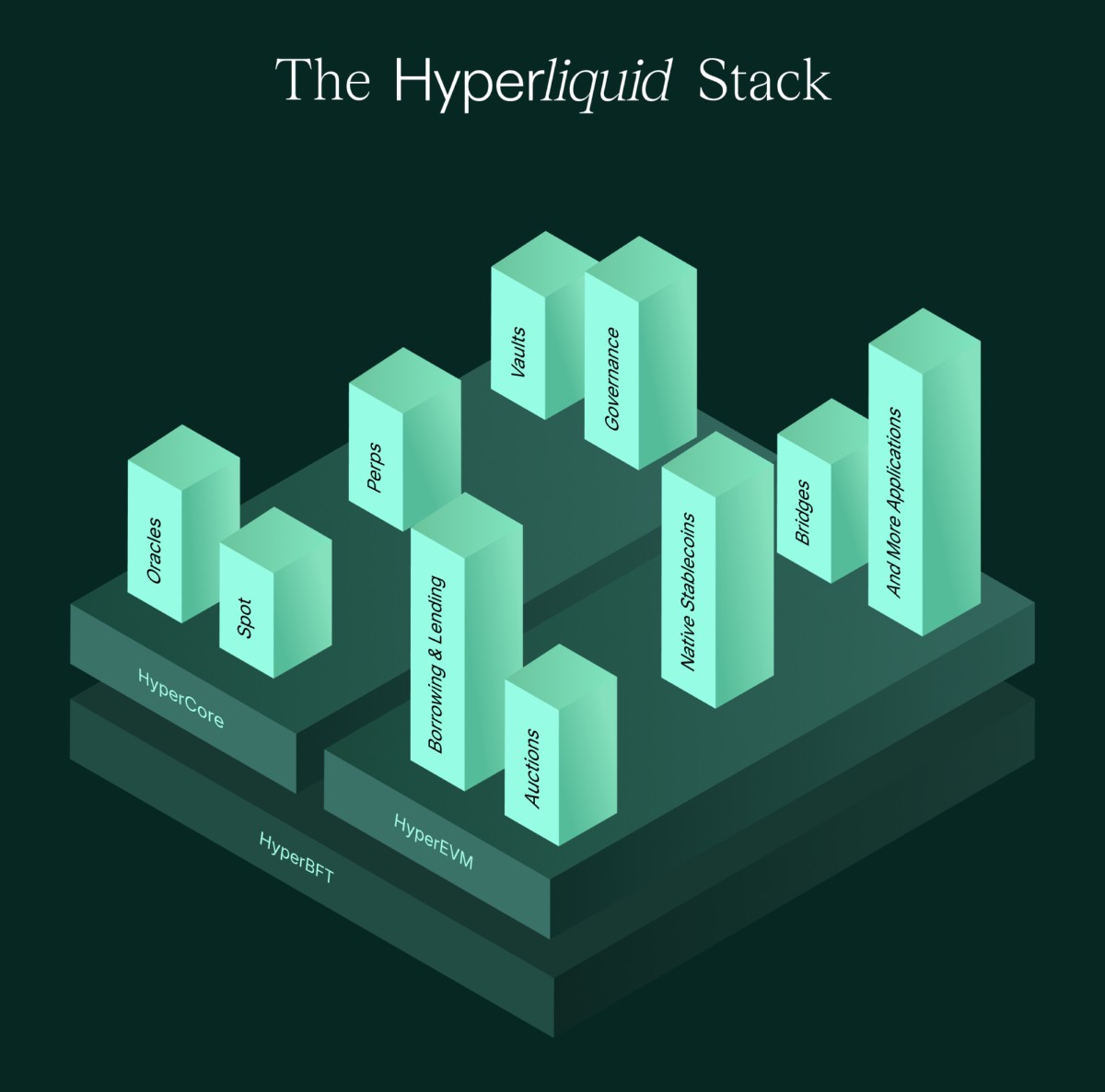
Hyperliquid’s architecture, with HyperCore and HyperEVM on top of the shared HyperBFT mechanism · Source: 2356094849-files.gitbook.io
HyperBFT
HyperBFT is Hyperliquid’s custom proof-of-stake consensus mechanism, inspired by HotStuff and later designs. Validators agree on the order of transactions, with a quorum of more than two-thirds of the weighted stake. Security assumes that this quorum acts honestly.
The validator set and their weights stay fixed for epochs of 100,000 rounds, about 90 minutes on mainnet. Unresponsive validators can be temporarily removed from participation and rewards through jailing. This differs from slashing, i.e. cutting stake for provably malicious behavior, such as double signing.
HyperCore
HyperCore manages order books, trade matching, margin, positions and liquidations. The documentation describes one-block finality and capacity of about 200,000 orders per second. This is the project’s stated capacity, not recorded daily usage or an independent benchmark.
For a client geographically close to the infrastructure, it cites a median order latency of 0.2 seconds and 0.9 seconds at the 99th percentile. We don’t carry these numbers over as-is to the experience of someone connecting from Greece. Nor do we relabel “orders per second” as general blockchain transactions.
HyperEVM
HyperEVM enables smart contracts compatible with the Ethereum Virtual Machine (EVM), within the same L1. It isn’t a separate Ethereum layer 2 network. HYPE pays for computation (gas), with both base fees and priority fees burned.
The environment is compatible with the Cancun upgrade, without blobs, and uses an EIP-1559-style fee design. The official technical page describes small blocks roughly every second, with a 3 million gas limit, and large blocks roughly every minute, with a 30 million gas limit. This serves different computing needs without a single block size for everything.
Special built-in functions (precompiles) read selected HyperCore data, while CoreWriter sends supported actions to it. The communication has ordering and timing rules: “same blockchain” doesn’t mean everything runs at the same time. HyperCore and HyperEVM balances are separate, and HyperEVM’s chain ID is 999.
Transfers use system addresses and require the correct route. The image below shows examples of moving assets between the two environments. For linked assets other than HYPE, the official documentation warns that arbitrary contract code may be involved, so we don’t take their security or equivalence for granted.
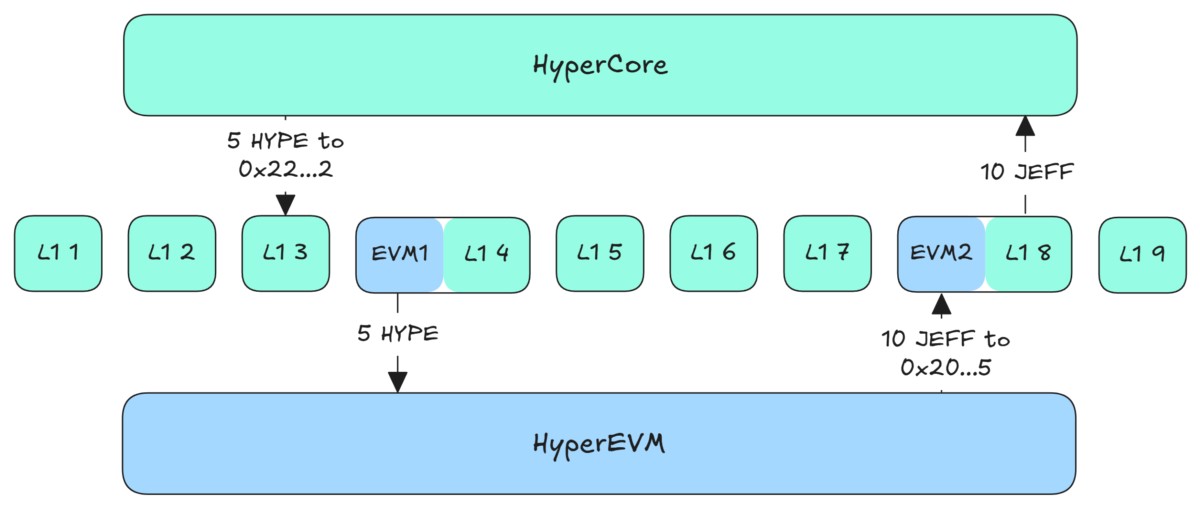
Examples of transferring HYPE and another token between HyperCore and HyperEVM · Source: 3973284896-files.gitbook.io
Liquidity and new markets
HLP, the Hyperliquidity Provider, is a vault of strategies that takes part in market making and liquidation processes. Depositors share the results, positive or negative. It isn’t a bank account or a guaranteed-interest mechanism.
Hyperliquid Improvement Proposals (HIPs) extend the network’s capabilities. HIP-1 defines a standard for native spot tokens and HIP-2 a liquidity mechanism for them. HIP-3 lets qualified third parties create perpetual markets, usually by staking 500,000 HYPE, with responsibility for rules and reference price mechanisms (oracles).
HIP-4 adds fully collateralized outcome contracts with an expiry, which can settle at zero or one depending on an event. It is a basis for prediction markets, not another name for perpetuals. Meanwhile, builder codes let external front ends route trades and charge a disclosed additional fee; such integrations don’t imply ownership of the protocol.
The HYPE token
HYPE links network security, applications and part of the exchange’s economic activity. It is used for staking, gas, fee discounts and the stakes posted by HIP-3 and HIP-4 market creators. Decentralized finance (DeFi) applications can also accept it as collateral or liquidity, taking on their own risks.
Supply and initial allocation
The initial reference supply was 1 billion HYPE, with 31% going to the genesis distribution. There was no initial allocation to private investors, centralized exchanges or paid market makers. This doesn’t mean investment funds didn’t acquire HYPE later on the market.
| Initial allocation | Share | HYPE |
|---|---|---|
| Future emissions and community rewards | 38.888% | 388,880,000 |
| Genesis distribution | 31% | 310,000,000 |
| Core contributors | 23.8% | 238,000,000 |
| Hyper Foundation budget | 6% | 60,000,000 |
| Community grants | 0.3% | 3,000,000 |
| HIP-2 liquidity | 0.012% | 120,000 |
In CoinGecko’s data snapshot of November 10, 2026, 02:00 UTC, circulating supply was 239.41 million HYPE and total supply 951.54 million. Market cap was $17.86 billion and the reported fully diluted valuation (FDV) $70.97 billion. A later snapshot showed 11th place and a market cap of about $18.01 billion.
The numbers are snapshots, not closing prices. CoinMarketCap showed a different supply classification and ranking, so we don’t mix data from different providers. Nor do we assume that all 310 million HYPE from the initial distribution make up today’s circulating supply.
Burns, rewards and unlocks
The assistance fund converts eligible trading fees into HYPE, which the official fees page describes as burned and permanently removed from supply. It isn’t unconditionally true that “99% of all fees are burned.” Creators of spot and HIP-3 markets can keep up to 50% of the fees from their own markets.
Against the burns stand the staking rewards from the future emissions reserve and gradual unlocks (vesting). Contributors had an initial one-year cliff followed by a multi-year schedule. On November 10, CoinGecko showed the next scheduled unlock of about 9.92 million HYPE on December 6, 2026; an unlock doesn’t mean a proven sale.
Burns reduce supply, but rewards and unlocks can increase the amount of HYPE in circulation at the same time.
Validators and stakers take part in governance through specific processes. Not every technical or business decision is made by a universal vote of holders. Also, HYPE is not a share with a contractual legal right to the exchange’s profits.
History and founders
Hyperliquid’s history is tied to Jeffrey “Jeff” Yan, who studied mathematics and computer science at Harvard and worked at Hudson River Trading. Crypto trading followed and, according to Fortune, he funded development from his own profits. The second co-founder uses the pseudonym iliensinc and is described as his fellow student; a confirmed legal identity has not been documented.
Hyperliquid Labs is the core development team, while the Hyper Foundation supports the network and ecosystem and takes part as a validator. Fortune described an 11-person team in January 2026, not necessarily today. The project says it is self-funded with no outside venture capital, while the same report mentioned later positions in HYPE by Paradigm and Andreessen Horowitz.
In the TOKEN2049 Singapore 2025 conversation below, Jeff Yan presents the team’s approach.
The journey includes major expansions, but also incidents that tested the infrastructure and the limits of validator intervention.
- 2022–2023 The collapse of FTX reinforces the team’s direction. The exchange and its own L1 launch in 2023.
- October 7, 2024 The Arbitrum bridge locks for about four hours after faulty data from several RPCs. The incident report says funds were not at risk.
- November 29, 2024 HYPE launches with the community distribution.
- February 18, 2025 HyperEVM launches, adding an application environment to the existing blockchain.
- March 26, 2025 The JELLYJELLY incident leads to the market being delisted and positions forcibly closed by validator decision.
- July 29, 2025 A traffic spike on the API delays orders between 14:10 and 14:47 UTC. The team distinguishes it from a hack or exploit.
- October 10–13, 2025 Market turmoil triggers automatic deleveraging. Bankless places the launch of HIP-3 on October 13.
- Late November 2025 The contributors’ initial cliff ends and unlocks begin.
- May 2 and August 29, 2026 A regulatory filing records a limited launch of HIP-4 and later the opening of market creation to third parties.
- September 29 – November 7, 2026 A U.S. congressional committee requests information on prediction market safeguards. Later, the official status page records scheduled upgrade maintenance.
In JELLYJELLY, CoinDesk reported a temporary unrealized loss of $13.5 million for HLP. We don’t equate it with a final realized loss. The decision to close positions, however, raised a fundamental question: how much discretionary intervention do we accept to protect a decentralized system?
On October 10, 2025, Bankless recorded more than 40 automatic deleveraging (ADL) events in about 12 minutes. Profitable counterparty positions were also reduced, with disagreements over the extent and fairness of the cuts. Managing extreme risk doesn’t only affect those who lose.
Of a different nature were the alleged private key compromise with a loss of about $21 million on the same day and the reported $550,000 loss through a fake search ad in August 2026. These are account security and phishing incidents, not evidence of a HyperBFT breach.
The ecosystem today
Hyperliquid has significant activity, but its figures measure different things. The total value locked (TVL) of the exchange protocol is not the same as the TVL of the chain’s applications. In the table, we keep the measurement scope and date separate.
| Metric | Snapshot |
|---|---|
| Exchange protocol TVL | $8.072 billion, DefiLlama, Nov 7, 2026 |
| TVL of the chain’s DeFi applications | $2.36 billion, dashboard with DefiLlama data, Nov 10, 2026 |
| Stablecoins on the chain | $6.48 billion, same dashboard, Nov 10, 2026 |
| Addresses | About 2.01 million all-time and 69,000 daily active, ecosystem tracker, Nov 3, 2026 |
| Open interest | $7.31 billion and 57% of tracked decentralized perpetual markets, Nov 8, 2026 |
| Cumulative notional perpetuals volume | Over $5.4 trillion through Aug 23, 2026, according to a regulatory filing |
We don’t add these amounts together, because they may overlap. Addresses don’t equal people, and open interest is not trading volume. A reliable, consistently defined total of transactions across the whole chain has not been confirmed in the available data.
On November 9, 2026, 22:12 UTC, an API-based tracker recorded 35 validators, 27 of them active, and about 439 million HYPE staked. The three largest, labeled Foundation, held 36.1% of the stake. Total stake may include amounts that market data providers don’t classify as circulating.
The main historical entry point for funds used USDC bridged from Arbitrum. In 2026, Coinbase described an alignment agreement around USDC and related rewards, not ownership of Hyperliquid. Meanwhile, the proposed U.S. regulated route with Payward/Kraken, Bitnomial and HIP-3* still required approvals and next steps as of late October.
Competitors
Hyperliquid competes with different technical models, not copies of the same architecture. Speed comparisons need care, because order latency, block time and confirmation are not the same metric.
| Project | Architecture and speed | Indicative cost | Token market cap |
|---|---|---|---|
| Hyperliquid | Its own PoS L1; stated median latency of 0.2 sec. for a geographically close client | Base taker fee of 0.045% on validator-operated perpetuals, before adjustments | $17.86 billion, Nov 10, 2026, 02:00 UTC |
| Lighter | Ethereum-oriented ZK-rollup; reported taker latency of 300 ms on standard accounts | A secondary guide from Nov 2, 2026, cites 0% maker/taker for typical standard orders; not all cases | $808.61 million, CoinGecko, intraday Nov 10, 2026 |
| Aster | Perpetual DEX linked to the BNB Chain ecosystem; no confirmed comparable latency | No directly comparable current base fee confirmed | About $1.66 billion, CoinGecko, Nov 10, 2026 |
| dYdX | Specialized PoS L1 built with the Cosmos SDK; no confirmed comparable latency | No directly comparable current base fee confirmed | About $76.30 million, CoinGecko, Nov 10, 2026 |
The taker trades against an existing order, while the maker adds an available order to the book. On Hyperliquid, staking discounts range from 5% to 40%, but volume, market and additional builder fees affect the cost. Funding, gas and slippage are separate costs.
The table above is not a controlled benchmark or a liquidity ranking. A token’s market cap doesn’t equal company value, protocol revenue or market depth. Lighter’s fee in particular needs to be confirmed against the current official fee schedule.
What it means for holders in Greece
For a holder in Greece, the first practical issue is the right network and keeping the keys safe. A compatible EVM wallet can interact with HyperEVM, while a supported hardware wallet keeps the keys offline. Custody by a third party adds its own custodial risk.
Before a transfer, check whether the recipient accepts HyperCore HYPE, native HyperEVM HYPE or another representation. The same ticker doesn’t guarantee a compatible deposit. The official documentation recommends a small test transaction on a new route.
Native staking requires transferring to the HyperCore spot balance, then to the staking balance, and delegating to a validator. Delegation has a one-day lock, while returning unstaked HYPE from staking to spot takes seven days. Rewards accrue every minute, are distributed daily and are automatically redelegated.
On November 9, 2026, 22:12 UTC, the tracker showed an annualized yield of about 2.17% for delegations to the largest validator, after its reported 3% commission. This isn’t a guaranteed interest rate: total stake, commissions, uptime, slashing and the HYPE price all change the result. Liquid staking tokens add contract and liquidity risks.
For the tax treatment in Greece, no specific rate or AADE (Greece’s Independent Authority for Public Revenue) guidance is documented here; keep a record of trades, rewards and fees and ask for a personalized professional assessment. Also, technical access does not amount to regulatory approval for offering derivatives in the user’s jurisdiction.
Information
The official documentation is Hyperliquid’s main technical reference. A traditional whitepaper written by the team has not been confirmed, so we don’t present third-party texts as its founding document.
| Website | hyperliquid.xyz |
|---|---|
| Whitepaper / documentation | Official documentation; no traditional whitepaper by the team confirmed |
| Explorer | HyperCore, HyperEVMScan, Hyperscan |
| Social - Community | X, Official announcements |
| Network status | Official status page |
Our take
We think Hyperliquid’s strength is the coherence between the application and its infrastructure. The team started from specific trading needs and built consensus, execution and then an application environment around them. The existing order book gives outside builders something more tangible than a general promise of future use.
We are concerned, however, about stake concentration and the small active validator set. Community documentation also notes that the L1’s source code was not publicly available in the material reviewed, limiting independent inspection. And JELLYJELLY showed that protecting the system can clash with the expectation of unchanging market rules.
On the economic side, we see a real mechanism linking eligible fees to HYPE buybacks and burns, not a guarantee of value. Activity may fall, the fee mix may change and unlocks may offset burns. That doesn’t turn HYPE into a conventional share.
The congressional request for information on prediction markets is not a court ruling or proof of wrongdoing, but it shows that expansion brings new obligations and questions. Our assessment is that Hyperliquid is a meaningful experiment in a specialized blockchain. The next test is whether it can maintain execution quality while improving transparency, independence and resilience in difficult moments.
Frequently asked questions
Did Hyperliquid get a blockchain after the exchange?
No. The exchange and its own L1 launched together in 2023. HyperEVM, added on February 18, 2025, extended the existing network with Ethereum-compatible applications.
What is HYPE used for?
It is used for staking, gas on HyperEVM, trading fee discounts and stakes posted by market creators. It also takes part in specific governance processes and can be used by DeFi applications.
Does HYPE staking have a guaranteed yield?
No. Rewards come from future emissions and vary. Validator, slashing, price and custody risks remain, while moving from staking back to spot takes seven days after unstaking.
Has the blockchain been breached in the known incidents?
The incidents described here don’t prove a breach of HyperBFT. They include a bridge outage, API delays, market intervention and account thefts; each category has a different cause and risk.