Monero (XMR): Privacy as a right, not a luxury
How Monero shields your transactions from prying eyes and why financial privacy matters.


 Monero (XMR) today
€482.56
+1.4% in 24h
Price and chart
Monero (XMR) is an independent payments blockchain that launched on April 18, 2014, and builds privacy into its everyday transactions. It limits public exposure of the amount, the recipient and the actual input being spent, although that does not guarantee complete anonymity. We will explain how it does this, who funds its development and why its usefulness comes with serious technical and regulatory hurdles.
Monero aims to keep digital payments from automatically turning into a public financial history.
| Coin | Monero, XMR. A native coin, not a token on another chain. |
|---|---|
| Launch year | 2014, originally as BitMonero. |
| What it does | Peer-to-peer payments with built-in transaction privacy. |
| Consensus mechanism | Proof of work, with RandomX. |
| Max / circulating supply | No fixed cap / about 18.826 million XMR as of November 3, 2026. |
| Market cap rank | #13 in the CoinGecko snapshot of November 3, 2026, about $11.413 billion. |
The problem
Public blockchains can reveal far more about our finances than we realize. On Bitcoin, for example, the transaction history of the base chain is transparent. An address doesn’t necessarily carry your name, but it can be linked to you through an exchange, a merchant or other information.
Think of a professional in Greece who pays suppliers and receives fees on the same public chain. If someone links the relevant addresses, they can try to map out that person’s business relationships. The need for confidentiality doesn’t imply anything illegal, just as not publishing our bank statements doesn’t imply anything illegal.
This is also where fungibility comes in: the idea that two units of the same currency should be treated as equal. When every unit carries a readable history, third parties can value it differently because of past transactions. Monero tries to limit that ability to discriminate.
Monero’s solution
Monero’s solution is privacy as the default rule, not as a separate option the user has to discover. A regular transaction combines different cryptographic mechanisms for the sender, the recipient and the amount. Protecting just one of them is not enough.
This serves payments, donations, transfers between wallets and commercially sensitive transactions. Of course, XMR has also been used on darknet markets, in ransomware operations and in unauthorized mining (cryptojacking). The technology does not certify that a payment is legal, nor does privacy prove wrongdoing.
The phrase “private by default” describes the protocol’s design. It does not mean that a recipient forgets who paid them, that an exchange keeps no records or that an infected phone is protected by the blockchain.
The technology
Nodes, RandomX and confirmations
The network relies on nodes that verify the rules and on miners who compete to produce blocks. The reference node software is called monerod, while the wallet manages keys, recognizes incoming payments and builds transactions.
RandomX, introduced in 2019, is designed around general-purpose processors, known as CPUs. It makes it hard to use specialized mining chips, ASICs, cost-effectively, without ruling them out mathematically. And, as we will see, lots of ordinary processors can still be pooled into one large mining pool.
The target is one block roughly every 120 seconds. Capacity adjusts to demand through rules and a penalty on the reward for sufficiently large blocks, not through unlimited space. Fees depend on transaction size, priority and network conditions, so a fixed transactions-per-second figure would give a misleading picture.
Ring signatures and double-spend prevention
Ring signatures make it hard to identify the actual output being spent. On mainnet as of the reference date, each ring has 16 members: the real output and 15 decoy references to other outputs.
Imagine an envelope that can be proven to have been signed by someone within a group, without showing who signed it. The other members didn’t hand you their coins to mix. The references act as cover, not as a transfer of other people’s money.
A cryptographic key image lets nodes reject a second spend of the same output. However, 16 members don’t always mean equal “one in sixteen” odds: historical data, decoy selection and information from counterparties can narrow the uncertainty.
The team’s video below explains the basic idea of ring signatures; it was published in 2017 and does not describe today’s parameters.
One-time addresses and hidden amounts
Stealth addresses protect the link between a payment and the recipient’s published address. The sender generates a one-time destination, and the recipient scans the chain with the private view key to recognize what belongs to them.
Spending requires a different key, the spend key. The image below shows conceptually how the keys relate to the one-time destination and how the wallet recognizes it.
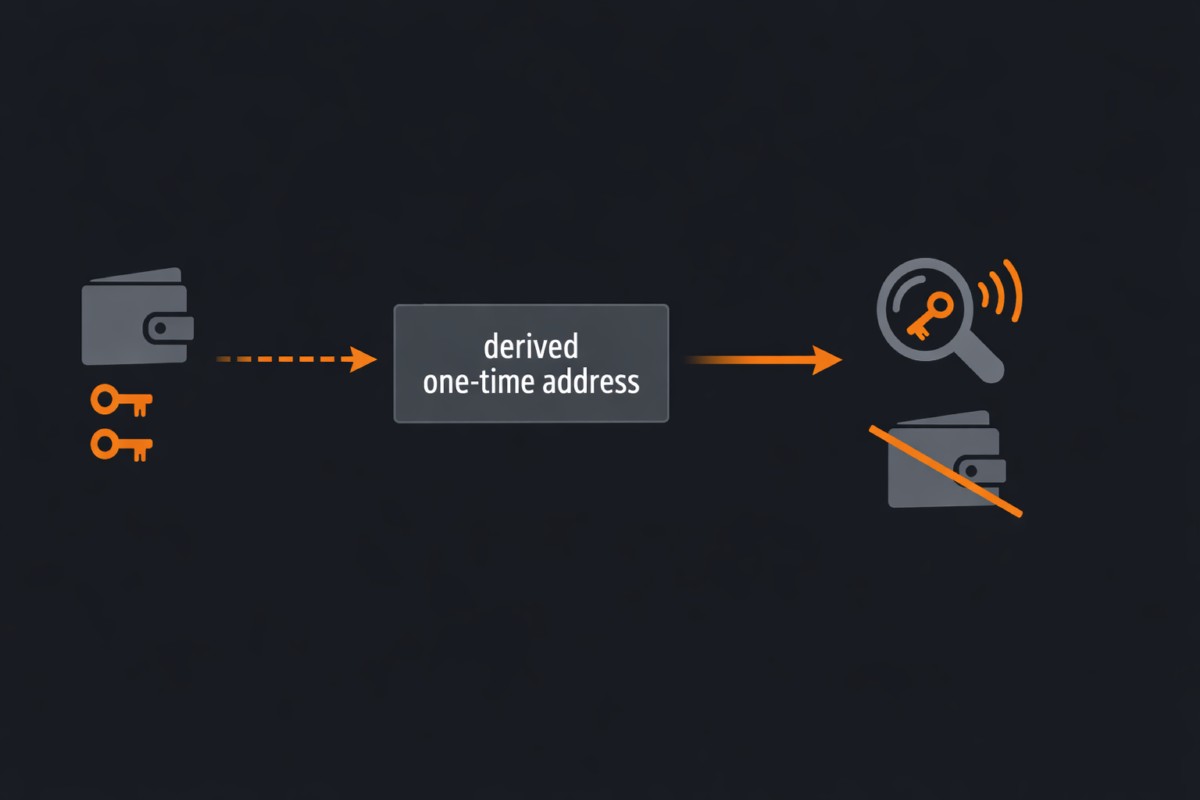
From the wallet’s keys to the one-time destination and recognition of the payment · Source: monero.how
Ring Confidential Transactions (RingCT) hide amounts with cryptographic commitments, while still allowing anyone to check that the values balance. Range proofs help rule out invalid hidden amounts. Bulletproofs in 2018 and Bulletproofs+ in 2022 reduced the amount of data required, while CLSAG in 2020 made signatures smaller and faster to verify.
The view key can be shared to audit incoming activity without, on its own, granting the right to spend. It remains sensitive data and does not automatically amount to a full accounting picture or regulatory compliance.
What remains visible
Monero does not make a transaction disappear from the blockchain. Its existence and timing, the fees, the structure, the key images and identifiable mining rewards all remain public. The recipient can also disclose information or payment-proof data.
Dandelion++ initially limits the path along which a transaction propagates before it is broadcast more widely, making it harder to link it to the originating IP address. It does not eliminate the risks from remote nodes and network surveillance. Nor are Tor or I2P a cure-all.
Protocol-level privacy doesn’t fix a compromised wallet or information the user reveals themselves.
Also, old transactions don’t retroactively gain all the protections of newer ones. Smaller historical rings and older constructions need to be assessed differently.
The upcoming FCMP++ proposal
Full-Chain Membership Proofs (FCMP++) aim to replace small rings with a proof of membership in a much larger eligible set of outputs. In doing so, they try to reduce weaknesses tied to choosing just a few decoy references.
The official 2024 description also includes transaction chaining and improved viewing capabilities, some of which require additional work in wallets. As of November 3, 2026, the upgrade was in testing and auditing, with no confirmed mainnet activation. A possible activation in 2027 was a non-binding timeline.
On August 17, 2026, MAGIC Grants announced an audit of the cryptographic implementation by Trail of Bits: five findings had been resolved and one partially. That reduces uncertainty; it doesn’t certify the entire future upgrade as risk-free.
The XMR coin
Supply and distribution
XMR pays for transactions and fees, while new issuance goes to miners along with the fees of valid blocks. According to the project, there was no premine, no privileged instamine, no token sale and no automatic withholding of rewards for development.
| Category | Allocation / mechanism |
|---|---|
| Founders and investors | No predetermined allocation by the protocol. |
| Token sale | None took place. |
| Miners | Receive new issuance and transaction fees. |
| Development | Donations, community crowdfunding and independent grants, not a built-in share of rewards. |
This doesn’t mean early participants didn’t acquire XMR through mining or buying. It means there was no contractual percentage table for a team, investors and a treasury, as we see in many newer projects.
By the switch to tail emission in 2022, about 18.132 million XMR had been issued. Since then, the base reward has been 0.6 XMR per block indefinitely: about 432 per day, or 157,680 per 365-day year at the target block rate. Actual issuance depends on the blocks produced.
There is no maximum supply. The absolute subsidy stays fixed, but the rate of new issuance relative to existing supply declines. It is a choice to fund security permanently, at the cost of ongoing dilution; no general recurring burn mechanism is documented.
On November 3, 2026, CoinGecko showed about 18.826 million XMR, while a block explorer recorded 18,826,004 XMR issued up to block 3,798,047. Issuance doesn’t show how many coins remain accessible or available for sale.
Market and no staking
Monero has no native staking and no yield from simply holding XMR. A third-party product promising “XMR yield” may use lending, custody or some other strategy. Mining, likewise, depends on hardware, difficulty, electricity, fees and luck, not a fixed interest rate.
In the CoinGecko snapshot of November 3, 2026, the price was about $606.33, the market cap $11.413 billion and 24-hour trading volume $141.379 million. CoinMarketCap gave a separate snapshot of $602.23, an $11.33 billion market cap and rank #12 instead of #13.
These differences shouldn’t be combined as if they were a simultaneous measurement. Likewise, the all-time highs on January 14, 2026, were $797.73 in data sourced from CoinGecko and $798.91 on CoinMarketCap. The fully diluted valuation shown does not describe any finite final supply, since no such cap exists.
History and team
Monero emerged from a community change of direction, not from a company with a recognizable founder at the helm. The pseudonymous thankful_for_today launched BitMonero from CryptoNote/Bytecoin code, not Bitcoin code. The community disagreed with proposed changes, a new core team took over and the name was shortened; “Monero” roughly means “coin” in Esperanto.
Nicolas van Saberhagen is the pseudonym linked to the earlier CryptoNote whitepaper, with no proof that this is the same person as the original creator. South African Riccardo “fluffypony” Spagni was an early contributor and lead maintainer, but he has said he did not found Monero. He is not its sole leader today.
- April 18, 2014 BitMonero launches and evolves into Monero.
- September 2014 The project recovers from a spam transaction attack and publishes early Monero Research Lab work.
- March 2016 A minimum ring size of three is introduced.
- January–September 2017 RingCT is activated and then made mandatory; the minimum ring size rises to five.
- 2018–2020 Bulletproofs arrive, followed by RandomX on November 30, 2019, and CLSAG in October 2020.
- June–August 2022 Tail emission begins, followed by 16-member rings and Bulletproofs+.
- April 27, 2024 The official description of the FCMP and FCMP++ proposals is published.
- August 17, 2026 The audit of the FCMP++ cryptographic implementation is announced, not a mainnet activation.
Development moves forward through Monero Research Lab researchers, maintainers and a wider circle of contributors. Changes are discussed and reviewed in public, but ultimately users, nodes, miners and services choose compatible software. There is no staking vote by holders and no single company that changes the rules unilaterally.
Funding comes from donations, the Community Crowdfunding System (CCS) and independent grants. No conventional founding venture capital round has been verified. A grant for an audit shouldn’t be passed off as a corporate investment.
The road has also included serious incidents. On November 18, 2019, malicious CLI binaries were distributed through the download infrastructure; the warning followed on November 19. It was a breach of software distribution, not proof that the cryptography had failed.
On September 1, 2023, 2,675.73 XMR were taken from the CCS hot wallet. The team disclosed this on November 4, said the source of the breach had not been determined and that the general fund would cover the affected proposals. It was not a theft from all holders.
On August 12, 2025, the founder of Qubic claimed his pool had reached 51% of the hashrate, after a six-block reorganization. The Block noted disputes and insufficient public data. A later academic analysis identified periods consistent with selfish mining strategies, not proof that all transactions were exposed or that XMR could be created without limit.
Research in 2025–2026 examined node eclipse attacks and, under specific conditions, linking certain transactions via Tor. A separate 2026 assessment concluded that issues in the original construction of aggregated range proofs did not leave the network vulnerable. Neither finding wipes out all privacy, nor does the other put an end to technical risk.
Ecosystem and competitors
Monero has measurable payment activity, but no reliable public user count. XMRList recorded 31,012 transactions on November 2, 2026, and an average of 28,229 per day over the previous 30 days. These don’t equal distinct people.
The same source estimated the hashrate at 6.81 GH/s and the average fee at 0.000237 XMR, about $0.14 at the indicative price we cited. Monero Observer estimated the largest pool at 28% on September 30, 2026. These are different time windows, not a synchronized snapshot of the network.
There are wallets and independent trading networks, such as Bisq and RetoSwap, that are not part of Monero. Atomic swaps depend on the implementation, direction and liquidity. No reliable figure for total users or a comparable amount of native DeFi has been verified.
| Network | Privacy / consensus | Block target | Indicative fee | Market cap |
|---|---|---|---|---|
| Monero | Built-in privacy, RandomX proof of work | 120 seconds | About $0.14, average on Nov 2, 2026 | $11.413 billion, #13 |
| Zcash | Shielded and transparent transactions, proof of work | 75 seconds | 0.0001 ZEC, about $0.11 for a specific simple payment in a block explorer | $19.37 billion, #11 |
| Dash | Optional mixing, proof of work and masternodes | About 2.5 minutes | No verified comparable measurement | About $593 million |
| Bitcoin | Transparent base chain, proof of work | About 10 minutes | Variable, no comparable dated measurement | About $1.54 trillion, #1 |
The market caps come from non-simultaneous CoinGecko snapshots of November 3, 2026. Block times are not guaranteed payment completion times, and the fees were not measured with a single method. In this particular snapshot Zcash was larger, so we don’t describe Monero across the board as the “largest privacy coin.”
What it means for Greek holders
For a holder in Greece, the key issues are safe storage, access and the limits of privacy. The official GUI and CLI wallets support self-custody, and there are third-party apps and compatible hardware wallets. Device and software compatibility needs to be checked against current information.
Running your own node gives you independent verification. A remote node is more convenient, but it adds dependence and metadata risks. The seed phrase and the spend key control the funds; losing them can mean permanent loss, and leaking them can mean theft. The 2019 incident explains why we verify downloads against signed hashes.
Regular incoming outputs generally need ten confirmations before they can be spent, about 20 minutes at the target block rate, with the actual time varying. This is not a staking lockup. More confirmations reduce, but don’t eliminate, the risk of a reorganization.
Binance removed XMR from its main platform in February 2024, and Kraken announced restrictions for Ireland and Belgium in April. Delistings affect access and liquidity, but they don’t prove a universal ban on holding it, nor that the same rules apply in Greece.
Tax treatment in Greece requires an individual professional assessment; no specific rate or special regime for XMR is documented here. On-chain privacy is not tax advice.
Resources
The official documentation should be read alongside the historical technical papers, not replaced by them. The original CryptoNote whitepaper and the second edition of Zero to Monero predate later upgrades.
| Website | getmonero.org |
|---|---|
| Documentation | Monero Docs |
| Whitepaper / technical papers | CryptoNote, Zero to Monero |
| Explorer | XMRChain, an independent public block explorer with no access to the hidden amounts. |
| Code | Monero GitHub |
| Social - Community | Official X account, Reddit community |
| Funding | Community Crowdfunding System |
Our take
We think Monero’s strongest feature is the consistency between its goal and its design. It doesn’t ask the user to remember a special privacy feature. The absence of a predetermined allocation and the public research work also convince us as features of the project.
We are concerned, however, about mining concentration, access restrictions and the complexity of the cryptography. A hidden ledger makes it harder to assess a possible undetected inflation bug. Audits are essential, not a magic wand, while proof of work has an energy cost and using Monero takes patience with syncing and scanning.
Our view is that Monero answers a real need for financial confidentiality. Tail emission provides an ongoing security subsidy, but it doesn’t suit those who see a fixed supply cap as essential. And FCMP++ will be judged by its audits, activation and real-world operation, not by how attractive its promise sounds.
Frequently asked questions
Is Monero completely anonymous?
No. It protects transaction data, but devices, counterparties, services and network surveillance can reveal information.
Is there a maximum number of XMR?
No. Tail emission issues 0.6 XMR per block indefinitely, with a declining rate of new issuance relative to existing supply.
Can I stake Monero?
There is no native staking. Any third-party yield has a different mechanism and its own risks, and mining is not an interest rate for holding.
Has FCMP++ been activated?
As of November 3, 2026, no mainnet activation had been confirmed. Testing and a cryptographic audit are not the same as a completed upgrade.