AKT: What is Akash Network?
Akash aims to let you rent computing power from an open marketplace of providers rather than rely on a handful of cloud giants.


Akash Network is a decentralized computing marketplace where customers rent processors, memory, storage, and graphics cards from independent providers. AKT plays a role in its operations and governance, and as of November 18, 2026, the project is in transition: a move to Solana has been approved, but the computing marketplace has not yet completed its migration.
Akash does not put a supercomputer on the blockchain. It puts an open marketplace in front of providers’ physical computers.
| Akash at a glance | Details |
|---|---|
| Token | AKT |
| Launch | Overclock Labs founded in 2015, first mainnet launched in 2020 |
| What it does | Connects customers with independent computing providers |
| Circulating supply | 299,925,103 AKT |
| Published maximum supply | 388,539,008 AKT, with parameters that can be changed through governance |
| Market cap | Approximately $153 million |
| Market snapshot timestamp | Nov 17, 2026, 23:51:38 UTC, CoinGecko data via Kairos Signal |
What problem does Akash solve?
Akash seeks to reduce reliance on a few major cloud vendors by creating competition among independent providers. When a single vendor sets prices, availability, and access terms, moving an application elsewhere can become difficult.
Imagine a Greek startup that needs powerful graphics cards for an AI model. It does not necessarily care who owns the machine, but whether it offers the right hardware, in the right location, with acceptable reliability. Akash aims to bring those options together in one marketplace.
It falls into the category of decentralized physical infrastructure networks (DePIN) because it connects blockchain with physical hardware. It competes with traditional cloud services, specialist GPU providers, and projects such as Render and Flux, although they do not all offer exactly the same service.
Its documentation advertises savings of “up to 85%.” We emphasize “up to”: the GPU model, availability, support, and comparison period all affect the bill. A lower price alone does not establish an equivalent service.
How does Akash Network work?
Providers compete for the workload
The customer specifies the resources they need, and eligible providers submit bids. The requirements are recorded in a YAML file using Stack Definition Language and include the processor, memory, storage, GPU model, location, and maximum price.
This mechanism is called a reverse auction: rather than buyers bidding the price up, providers compete to serve the customer. The image below illustrates this difference; it concerns the bidding process, not the token’s current mechanics.
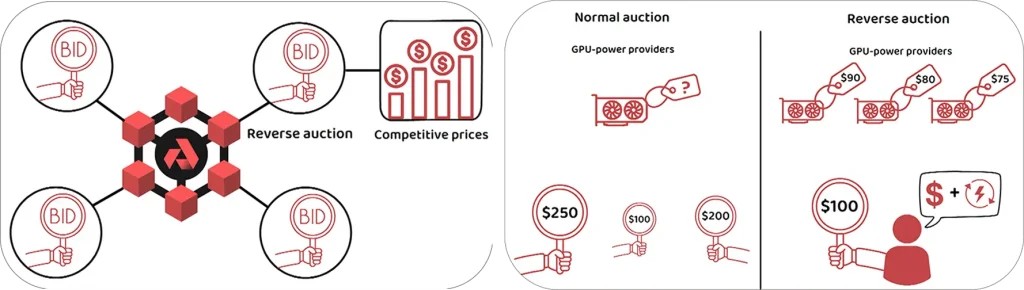
Standard and reverse auctions, with GPU providers competing for the customer’s workload · Source: iexplaincrypto.com
The customer selects a bid without being required to choose the cheapest. A lease is created, an escrow account is funded, and the funds are used as the workload runs.
The application runs on the server, not the blockchain
The software runs on the selected provider’s physical machines, inside application containers. The blockchain coordinates the marketplace and settlement, not the computations performed by the model or website.
This distinction matters for security and availability. You can close a lease, but while it is running, you remain dependent on the provider. A decentralized marketplace does not eliminate the need to vet the vendor.
Console, AkashML, and the current network
Akash offers different ways to access its services, depending on how much technical responsibility you want to take on. Managed Console provides a managed wallet and card payments, while Console Air and command-line interface (CLI) tools are geared more toward those using their own wallets.
AkashML is a managed service for running open models to generate outputs, a process known as inference. It launched in November 2025 and offers an application programming interface (API) compatible with OpenAI-style integrations, but it is not an OpenAI product.
As of November 18, 2026, the operating marketplace remains connected to akashnet-2, a Cosmos SDK proof-of-stake chain with CometBFT-style consensus. Holders can delegate AKT to validators through staking and participate in governance.
The vision and the transition to Solana
Akash is evolving from a general-purpose computing marketplace into broader infrastructure, with a focus on GPUs and a more predictable supply of resources. Its progress includes products already delivered as well as plans still under development.
- 2014–2015 Greg Osuri and Adam Bozanich begin the work that leads to Akash. Overclock Labs is founded in 2015.
- September 25, 2020 Mainnet 1 launches.
- August 2023 Mainnet 6 adds GPUs, including Nvidia A100 and H100 models. AMD support follows during 2023.
- October 28 and November 2025 Mainnet 14 arrives with a Cosmos SDK upgrade, followed by AkashML.
- March 23, 2026 Akash reports that the BME mechanism has been activated on mainnet.
- During 2026 Reports describe a Homenode beta/MVP for smaller GPU providers and the delivery of support for confidential compute, InfiniBand, and ARM64.
- November 2, 2026 Proposal 346 to migrate to Solana is approved.
- November 12, 2026 A report relays an Akash announcement that the token migration portal has opened. Its operation and the associated audit reports have not been independently confirmed in the available evidence.
Approval of the Solana move does not mean all of Akash has migrated. Proposal 346 received approximately 97.3% support among recorded votes, with abstentions included in the denominator—not among all AKT holders.
The plan calls for a one-way, 1:1 conversion of AKT. Migrating the marketplace requires a separate governance decision, audits, and testing, with no documented completion date. A 90-day period to wind down operations on the old chain is planned afterward.
The team expects lower chain maintenance costs and access to the Solana ecosystem. The trade-off is reliance on Solana and the loss of its own validator security model and native IBC interoperability. Current staking rewards are expected to continue until the marketplace migrates, but the future model has not been fully clarified.
Managed application infrastructure services and provider incentives have December 2026 targets, not guaranteed delivery dates. Compute Forwards, a marketplace for future computing capacity, states that nothing is live yet and targets a pilot launch in early 2027. Starcluster and Starbonds are described as plans for more predictable GPU supply and equipment-backed financing, not as demonstrably completed services.
How do AKT and ACT tokenomics work?
AKT currently serves staking, governance, and transaction fees, while BME connects it to funding computing workloads. It has six decimal places and an initial supply of 100 million tokens.
| Initial allocation | AKT | Share of initial supply |
|---|---|---|
| Investors | 34,510,788 | 34.51% |
| Team and advisers | 27,000,000 | 27.00% |
| Decentralized Cloud Foundation | 19,689,212 | 19.69% |
| Ecosystem | 8,000,000 | 8.00% |
| Testnets | 5,000,000 | 5.00% |
| Vendors and marketing | 4,000,000 | 4.00% |
| Public sale | 1,800,000 | 1.80% |
The Blockworks transparency filing states that vesting of the initial allocation ended in March 2023. This does not establish that the tokens were sold or distributed more widely. Investors, the team, and advisers received a combined approximately 61.51% of the initial supply, not the maximum supply.
A network snapshot taken around November 18, 2026, showed annual issuance of approximately 12 million AKT and a 4% inflation parameter. These parameters can change. Because the available sources disagree on the interval at which issuance is halved, we do not present any such schedule as confirmed.
Similarly, DefiLlama’s “undisclosed unlock” label warrants investigation but does not, on its own, establish a new hidden team unlock. The published maximum supply is also not an immutable rule beyond the reach of governance.
What does the BME mechanism do?
The burn-mint equilibrium (BME) mechanism uses ACT as a dollar-denominated computing credit. ACT is nontransferable and is not a conventional stablecoin.
You fund ACT with AKT, or through a managed card payment that acquires AKT in the process. The credits pay for leases, and the provider receives AKT based on the relevant reference price from a price oracle. The system includes a reserve accounting mechanism, reminting credits, and circuit breakers.
BME does not guarantee a permanent supply reduction for every dollar spent. If AKT rises in price between funding and payment, fewer tokens may be needed; if it falls, more issuance may be required, subject to the mechanism’s safeguards. The oracle’s availability and accuracy remain critical.
Who is behind Akash?
Akash has a publicly identified team, with Overclock Labs as its core development company. Greg Osuri and Adam Bozanich are listed as its founders in 2015, with Osuri serving as CEO and having previously worked on AngelHack.
The company’s website also lists Cheng Wang as co-founder, COO, and CFO, and Artur Troian as chief architect, without establishing that they held the same historical roles at Akash’s original founding. The Decentralized Cloud Foundation plays a supporting role, but corporate ownership is distinct from AKT governance.
Blockworks names DACM, Infinite Capital, Cypher Capital, Satori Research, and angel investors as participants in funding rounds. There is no evidence establishing that they all still hold AKT or the prices at which they invested.
Akash Network resources
Official documentation and governance decisions should take priority over older presentations. Historical papers do not fully describe the current BME mechanism or the transition to Solana.
| Resource | Official link |
|---|---|
| Website | akash.network |
| Documentation | Akash Docs |
| Roadmap | Roadmap 2026 |
| Original position paper | Historical design |
| Economics paper | Historical tokenomics model |
| Code | GitHub |
| Community | X, Discord, Reddit |
Our take
We see Akash’s operating marketplace and measurable usage as strengths: it offers more than promises. On November 18, 2026, at approximately 00:43–00:44 UTC, Kairos Signal relayed Console data showing 687–688 active leases, 54 providers, and 241 active GPUs. This is a snapshot, with possible differences in definitions between trackers.
Akash reported cumulative spending on computing services of more than $5 million in the first quarter of 2026 and 1.7 billion text tokens per day for AkashML on OpenRouter. The latter are not AKT. TechRadar also reported on a Razer campaign in April 2026 involving more than 11,000 images—not a migration of its entire infrastructure to Akash.
These figures demonstrate usage, not necessarily profitability or income for holders. Nor do the 128,604 X followers recorded by a third-party tracker on November 17 establish the number of active customers.
Security requires more scrutiny than a “verified provider” badge. ChainLight described a critical authentication bypass, fixed on May 1, 2024, without documenting exploitation against customers. Provider infrastructure checks are not equivalent to a full code audit, and the available evidence did not confirm a completed independent report covering the chain, provider software, or BME.
CertiK’s statement that it has not audited the project does not prove the absence of any other audit. Similarly, the two independent audits required by the migration plan cannot be considered verified simply because a portal was announced. Confidential computing support also needs to be confirmed for the specific machine and the customer’s configuration.
Liquidity remains a separate risk. The market snapshot showed a price of $0.510179 and a valuation of approximately $198.2 million based on maximum supply, which is not necessarily the fully diluted valuation metric used by every platform. AKT was listed on Coinbase, Kraken, Gate, Bitvavo, KuCoin, Bithumb, and Crypto.com Exchange, with support varying by country and platform.
In a separate observation, Coinbase’s AKT/USD market showed order book depth of approximately $231,000 at +2% and $179,000 at −2%, not guaranteed executable amounts. Blockworks also describes approvals of 3.5 million AKT in 2025 and 1 million in 2026 for liquidity provision, involving loans and call options to unnamed counterparties. The 2026 disbursement account is described as controlled by a single signature: a transparency issue, not proof of manipulation.
Osuri also issued a public clarification in October 2020 about circulating supply and accumulated staking rewards; we do not turn that into an allegation of fraud. Our main focus is recurring demand, provider reliability, token concentration, and execution of the migration. If you use Akash from Greece, coordinating with your exchange and avoiding unofficial migration links are more practical steps than any slogan. This article is not a recommendation to buy or sell.
Frequently asked questions
Do I need AKT to use Akash?
You can use your own wallet or managed card payments. In the latter case, AKT may be acquired as part of the funding process.
Has Akash already migrated to Solana?
The move has been approved, but as of November 18, 2026, the marketplace migration has not been completed. Token conversion is a separate stage.
Is ACT a stablecoin?
Not in the usual sense. It is a nontransferable, dollar-denominated computing credit used to pay for services.
Does greater usage guarantee a rise in AKT’s price?
No. Usage indicates demand for services, but issuance, BME settlement, liquidity, and market conditions affect the token separately.