LABS Group
LABS aims to shake up the traditional real estate investment model by creating the first blockchain for the general real estate market.


The real estate market
According to HSBC’s Global Real Estate report, published in 2016, the total value of the world’s real estate was estimated at 228 trillion dollars, growing at 5% a year.
The biggest contributor to global real estate investment is North America, followed by Europe, the Middle East, Africa and Asia.
The Global Real Estate report suggests there is strong demand for real estate investment opportunities internationally.
LABS Group
LABS aims to shake up the traditional real estate investment model by creating the first blockchain for the general real estate market. LABS’ vision is to disrupt real estate investing through the first real estate tokenization ecosystem based on fractional ownership.
Headquartered in Hong Kong, with a presence in China, the US and Europe, LABS has global partnerships in both blockchain-based technology and real estate. The LABS group operates in the US, China, Europe, the Middle East and other parts of Asia.
The problems of today’s real estate market
The initial capital the average everyday investor needs to make their first moves in the real estate market is high. The entry price gets even higher when it comes to investing in properties in big cities or cosmopolitan tourist resorts.
Here is a telling example. A worker who can steadily save 300 euros a month would need 22 years to buy an apartment in Nea Filadelfeia, Attica, that costs 80,000 euros. On top of that, it would take at least another 15 years to recoup the initial investment if they plan to rent it out rather than resell it.
On the face of it, there are two obstacles. First, the high cost of entering the real estate market, which goes up further once you factor in middlemen and various bureaucratic fees. In addition, we can see that it takes a significant amount of time to recoup the initial capital.
What’s more, the example above doesn’t account for the time needed to find the property to invest in, the bureaucratic or legal hurdles, or any other “surprise” that real estate investing involves.
Now suppose the ordinary investor’s investment is not in Nea Filadelfeia, Attica, but in Philadelphia in the US. Investing outside your own country’s borders becomes even more complicated once you consider the laws and procedures involved.
What LABS proposes
LABS aims to break up the traditional real estate market using blockchain technology. Real estate investments will be divided into smaller units with the help of NFTs. Each investor will hold an NFT representing partial or full ownership of a property. By adding more property NFTs, an investor can build their own global investment portfolio.
Returns will also be proportional to each holder’s ownership share. Ownership NFTs will be tradable for other securities regardless of geographic location, since everything happens on the blockchain. Buying, selling or even swapping NFTs will take place on the platform LABS provides, which will be open around the clock.
Moving the real estate market onto the blockchain, combined with fractional ownership, will lower the barriers to entry for real estate investing. That will let more investors take part in real estate markets that were previously out of reach. It will allow the market to be flooded with a new type of investor: those who don’t have the initial capital to enter the real estate market. According to LABS, real estate investments will start from 100 dollars.
The LABS tokens
The LABS ecosystem consists of three kinds of tokens. Each token plays an important role in running the wider ecosystem.
1. LABS Stable Token ($USDL)
LABS will launch its own stablecoin (USDL), pegged one-to-one to the US dollar. The purpose of USDL is to become established as a stable means of paying dividends to investors.
2. LABS Token Utility Token ($LABS)
LABS utility tokens play multiple roles in the LABS ecosystem.
Holders of LABS utility tokens will get priority access to real estate investments. They will also get priority when it comes to choosing the properties they are interested in. On top of that, they will get discounts on property prices. This discount will be proportional to the amount of LABS each prospective investor holds.
In addition, governance in the LABS ecosystem will be exercised in proportion to the LABS each investor holds. The more LABS you hold, the more votes you get on governance matters on the platform.
LABS tokens are designed as digital shares, so that they embody ownership and the underlying assets. Dividends from investments will be distributed automatically in USDT and/or USDL. If an investor takes part in a project, they will receive two kinds of dividends. The double dividends come from the investment in the property, but there is also the option to receive the same dividend in LABS tokens.
For example, if you invest in a property that pays you an 8% annual return in USDL, LABS says it will match the value of the dividends with a LABS token that can be sold or used further within the LABS real estate ecosystem.
You can then stake the LABS tokens you have earned, and they will also be entitled to a share of the total rewards paid out, as decided by community governance. This can reach 80% APY.
LABS tokens also solve the liquidity problem that big developers face. By creating a shared pool, LABS lets every holder of its tokens contribute a share of LABS tokens and automatically become a backer of the project. Each investor is then paid according to their share.
In other words, LABS tokens can be traded on the LABS exchange and provide the liquidity that the traditional real estate investment market can’t offer. Providing liquidity is one of the most important aspects of LABS.
3. LABS NFTs
LABS will use non-fungible tokens (NFTs) to represent physical assets. NFTs can represent anything from a real estate fund, a commercial building or a unique asset such as a house, all the way to rooms in a hotel. NFTs can also represent shares of the underlying asset, or be turned into a tradable security by issuing a token based on the underlying NFT, which makes it tradable on the secondary market, depending on the needs of each project owner.
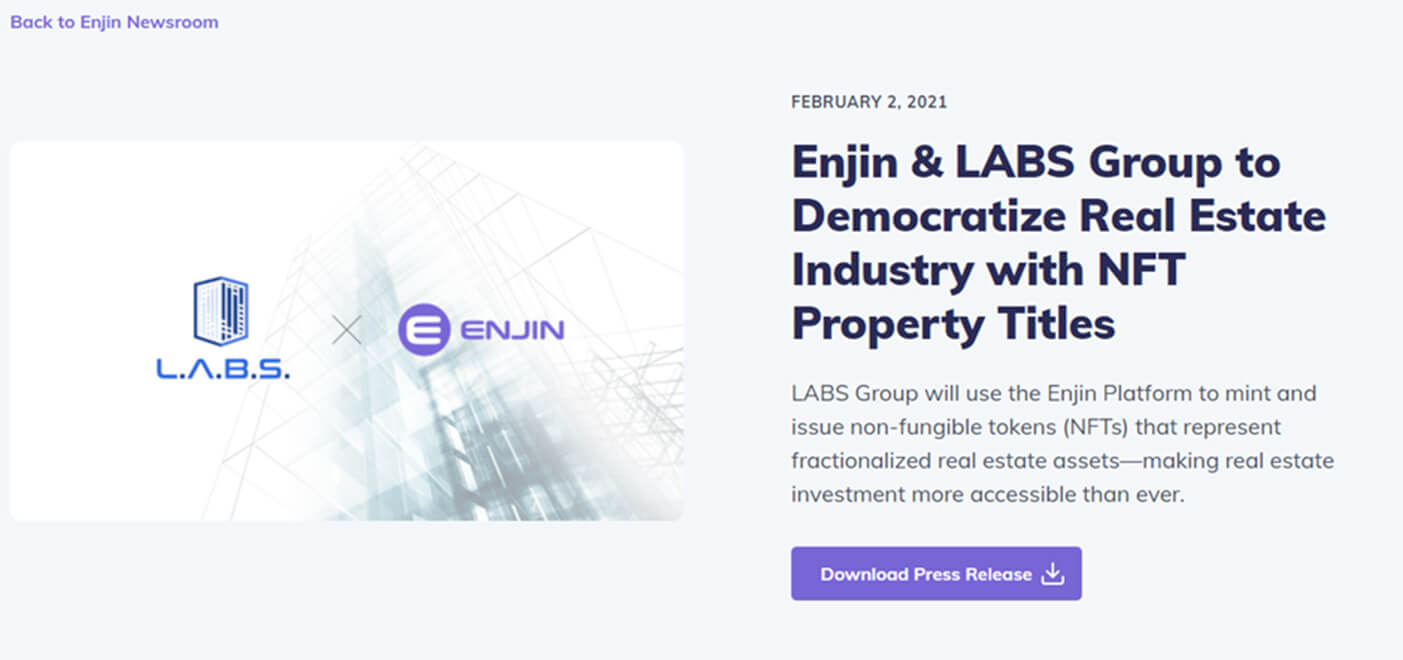
For every trade or purchase of an NFT, the property will retain a percentage of the value created; that value will be in LABS or other crypto variants (such as ETH).
Since each property has its own set or sets of NFTs, there is potential for a significant marketplace ecosystem to emerge, as well as big profits.
The types of NFTs:
- Real estate: single-family homes or other property types, hotel rooms, etc.
- Funds: fund-specific, possible variations or discounts on access to a specific fund portfolio, etc.
LABS Market place
The LABS Market place will allow ownership titles to be traded. The Market place will act as a hub bringing all investors together to trade assets (the NFTs). The intention is to let investors share out some of their assets to make it easier to diversify their portfolios. The property exchange marketplace will allow two asset owners to swap assets directly.
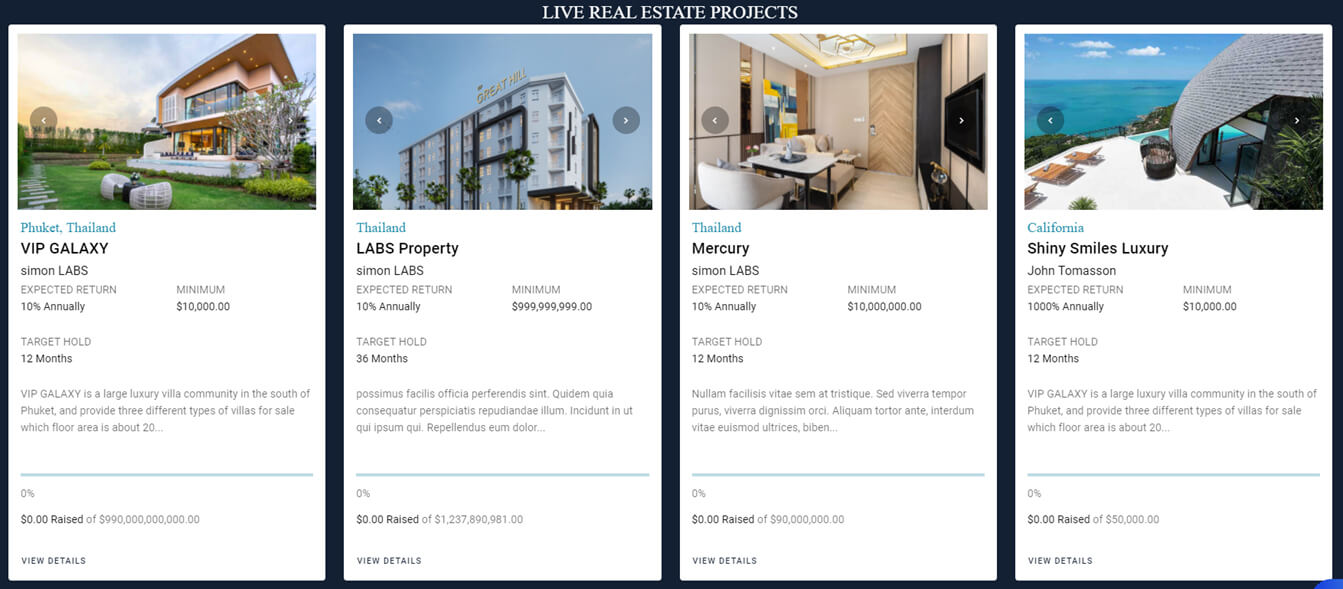
LABS will operate as one of the world’s first exchanges for financed real estate, based on NFTs and blockchain technology. The exchange will give investors the chance to cash out their assets directly on the exchange, providing instant liquidity. In addition, the exchange will let retail investors buy assets on the secondary market that they would otherwise not have access to.
Property owners who want to sell a completed property that can guarantee a rental yield can make investment offerings directly on the exchange. This gives developers a way to quickly sell part or all of their project directly on the secondary market. The $ LABS token can be used to offset trading fees with discounts. Both $ LABS and $ USDL will be tradable on the Security Token Exchange.
You can find the LABS Market place here.
Business model
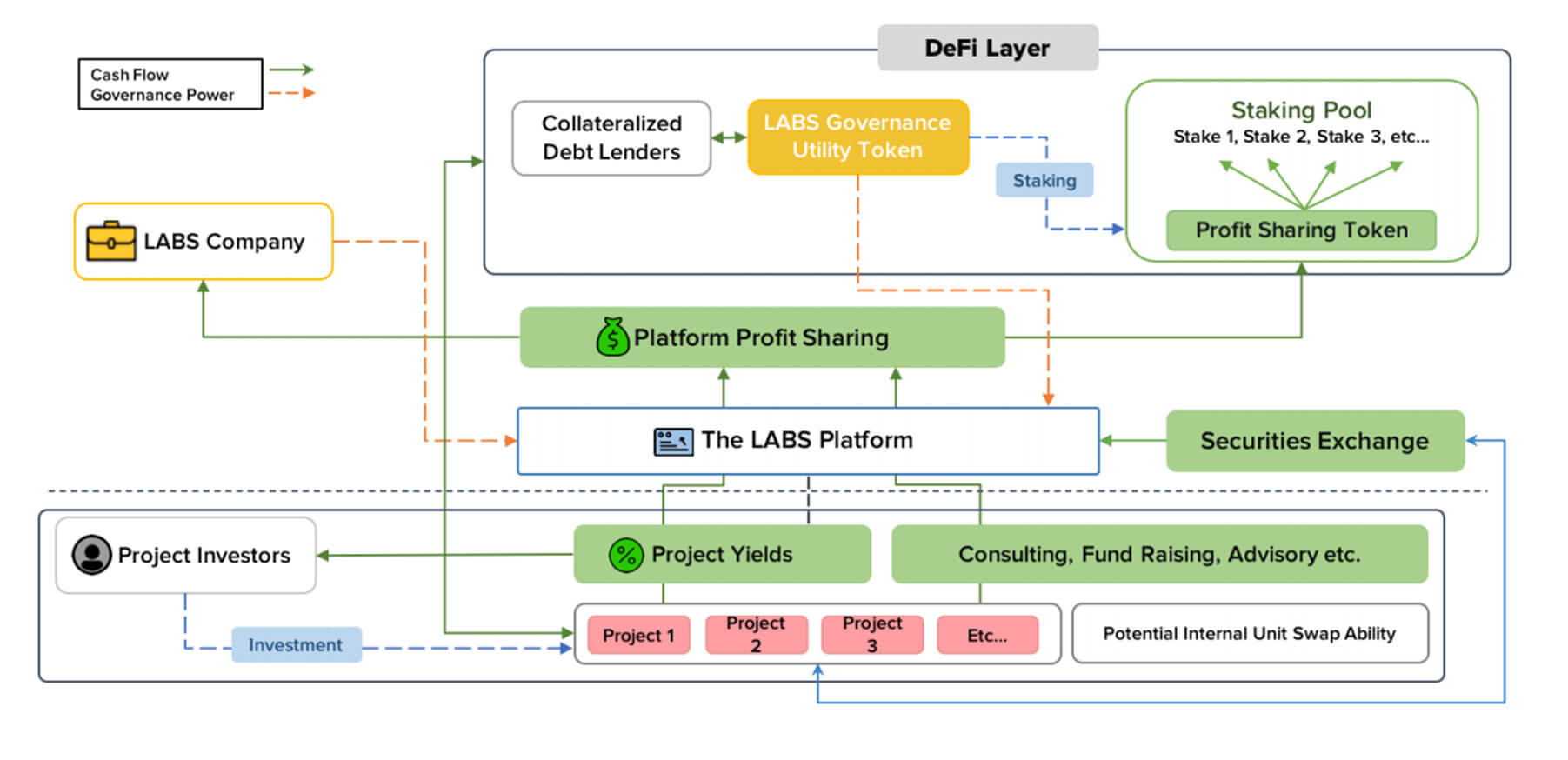
The chart below shows the LABS business model. The foundation of the LABS business model is the properties registered on its platform. LABS’ revenue comes from fees charged to owners for the services LABS provides to the legal owners.
Part of LABS’ profits is deposited into the shared pool, which in turn is distributed to the participants who have invested in the property. The distribution is based on the amount of LABS each participant has staked. In addition, a governance vote will be held every 6 months to determine how much of the profits goes into the shared pool.
LABS will reinvest the profits it makes to bring more projects to the platform.
Real use cases
LABS has been operating since early 2019. Since then it has worked with many clients in a variety of ways. Here are some real use cases that have worked with LABS.
1. Use case
A resort in Laos, run by one of the three presidents of the President resorts in Las Vegas, was looking for help raising two hundred million dollars in capital. The investor turned to LABS for the capital raise and ultimately raised the required capital through LABS, far more cheaply than going to a traditional investment bank.
LABS helped with consulting on the allocation and tokenization of its assets, and with finding and raising capital. The resort is expected to be completed in 2021.
2. Use case
LABS will work with a large New Zealand real estate fund to tokenize a traditional GP/LP fund structure and help raise capital to acquire multiple commercial properties in New Zealand. The fund has a 30+ year track record with no losses for its investors and is looking for new ways to attract new investors to build its business. LABS will help it structure, market and raise the required amount.
Polkadot Substrate
LABS will be built as a parachain on Rio Chain (www.riodefi.com), a Polkadot substrate. The substrate is built for DeFi, taking advantage of the ecosystem’s ability to interoperate with popular blockchains, such as Ethereum’s ERC-20.
The parachain will allow LABS to overcome the problems seen on the Ethereum network (slow transactions, high gas fees). The Rio Chain bridge will let LABS move between the Polkadot ecosystem and Ethereum’s, eliminating the problems mentioned above.
Imagine an investor trying to invest in a property. During the transaction, their ERC-20 transfer gets stuck for hours because of high gas fees. Investors may panic and not understand what to do. This is very damaging for everyone, as the user panics and LABS’ reputation suffers.
Tokenomics
Use of funds
- Marketing - 30% will be used for marketing expenses, for example events and community-building gatherings. Advertising and public relations are LABS’ biggest expense, as public relations are vital for a new, up-and-coming project.
- Software Development - 20% will go to the development and ongoing maintenance of the LABS ecosystem.
- Operations - 25% will be used to run LABS’ day-to-day activities. This includes, for example, salaries, office rent, utilities, hosting, and upgrading/maintaining the software it will use.
- Asset Acquisition - 15% will go to property purchases that LABS will own and maintain. LABS’ property purchases will benefit LABS token holders, as the assets will be listed on the market place for LABS token holders to use.
- Rewards - 10% for a reserve rewards pool, which LABS can use to offer its token holders additional rewards.
Total tokens (LABS): 10,000,000,000 Supply
- Investors - 20% will be sold to private and public investors with different wallet lock-up periods.
- Team and Advisors - 15% will go to the team and advisors. The tokens will be locked for 2 years. After that they can be sold on exchanges or markets.
- Partners - 5% will be set aside for various public relations efforts, which may need to involve the LABS token as a medium of exchange; the 5% will be for ecosystem-building purposes.
- Ecosystem/Treasury - 50% will go to LABS’ various needs.
- Reserve - a 10% reserve will be held in LABS tokens as an emergency fund for the business. These funds are not expected to be used, but if something comes up, LABS reserves the right to use them to fund the business if needed.
Roadmap
See the LABS roadmap here.
The team
The LABS team and advisors come from a mix of traditional business and blockchain expertise.
| Chairman | Mahesh Harilela |
| Chief Executive Officer | Yuen Wong |
| Managing Partner | Patrick Tang |
| President | Calvin Ng |
| Chief Strategy Officer | Boris Chan |
| Chief Technology Officer | Leonidha Zhezha |
| Head of China | Eileen Xie |
| Chief Blockchain Architect | Joshua Peng |
| Head of America | Francis Berwa |
| Head of Capital Markets | Jeff Reed |
Partnerships
Key facts
| Hard/Cap: | 400 million |
| Initial market cap: | 3.8 million |
| Website: | https://labsgroup.io/ |
| Social - Community: | GitHub, Medium, Reddit, Twitter, Telegram |
| Whitepaper: | Whitepaper |
Our take
Buying and investing in real estate is a huge market that, to this day, has not yet been tapped on any blockchain. A project that manages to enter this market would be revolutionary, as it would capture a huge share of it. LABS’ vision is to bring the average investor into real estate investing.
However, there are many obstacles LABS has to overcome first. What LABS is trying to do is bring two worlds together: the real world of real estate and tokenization.
Real estate is governed by laws and rules that are firmly established in every country. To get past these legal safeguards, LABS will need to muster enormous diplomatic strength for its venture to go mainstream
Also, the project has existed for about 2 months now and the platform still doesn’t exist. That said, our research has shown us that the team is steadily working on building it. Partnerships are still being announced on their social media, and we are also reassured that the team is made up of people with years of experience in real estate investing worldwide.
The LABS IDO started off as a huge success, giving investors a return of around 600%. After that the price went downhill. The main reason is the release of an extra 5% of tokens onto the market on the 15th of every month, which weighs on the price of the LABS token.
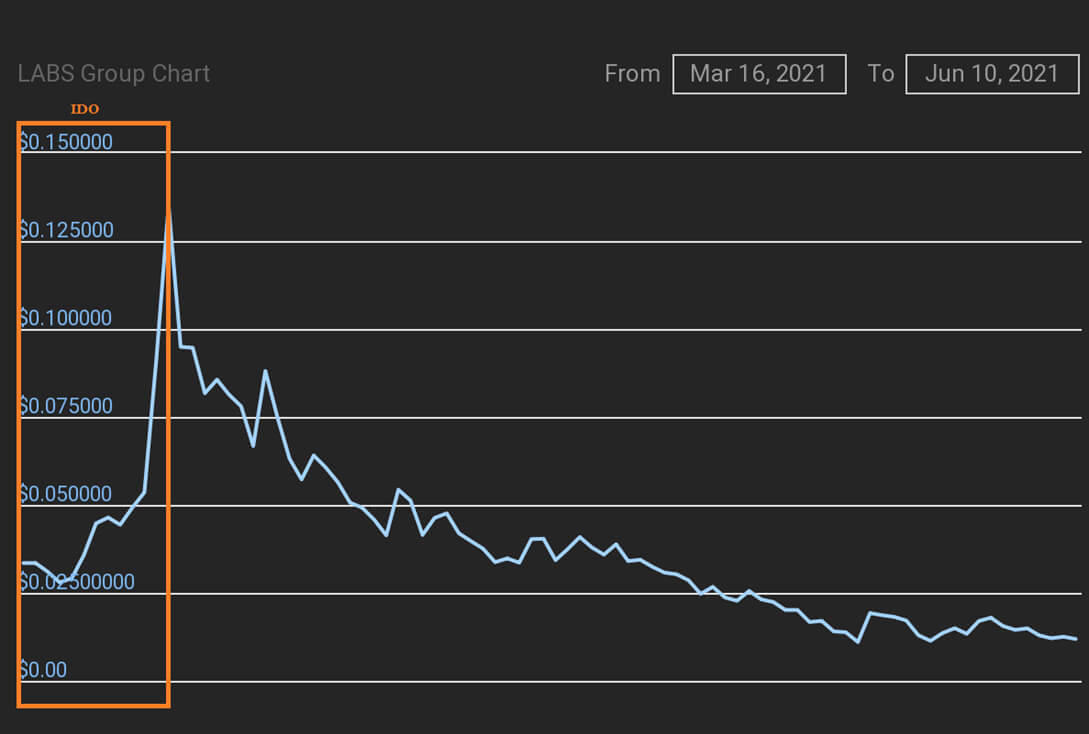
The reason we recommend this project is its radical vision and the size of the market it wants to break into, as well as the lack of competition from a similar project on the blockchain. We also really like that LABS has found a meaningful use for NFTs, as it is a real-world application of this technology.
We think this project still has a long way to go, but at the same time it has a lot to offer. With its token price at low levels, this may be the right time to buy.
To sum up, we think an investment in this project carries extremely high risk, which in turn can offer an extremely high return on the initial capital.