MEGA: what is MegaETH
The idea behind MegaETH is to make Ethereum applications respond with the immediacy we expect from the everyday internet.


MegaETH is an Ethereum Layer 2 (L2) network, compatible with the Ethereum Virtual Machine (EVM), designed for applications with very fast response times. Its public mainnet launched on February 9, 2026, while MEGA, its token, entered circulation and began to be distributed on April 30, 2026. Its promise is trading, games and payments without annoying waits, but with specific trade-offs in decentralization.
MegaETH’s bet is to concentrate the demanding work of block production on specialized infrastructure, letting different nodes handle updating and verifying the network.
| Item | Description |
|---|---|
| Network / token | MegaETH / MEGA |
| Developer | MegaLabs, founded in early 2023 |
| Mainnet launch | February 9, 2026 |
| What it does | Ethereum L2 for low-latency applications |
| Total / max supply | 10 billion MEGA |
| Circulating supply | About 1.13 billion MEGA |
| Price / market cap | About $0.0507 / $57.3 million |
| Fully diluted valuation | About $507 million |
| Network fees / Chain ID | ETH / 4326 |
The market data is a CoinGecko snapshot taken on November 11, 2026, not closing prices. Fully diluted valuation (FDV) calculates the value of the entire supply at the current price.
What problem is MegaETH trying to solve?
MegaETH aims to reduce the delay between sending a transaction and seeing its result. Think of a game that pauses for a confirmation, or a trading platform whose order book refreshes slowly: the experience suffers, even if the transaction is cheap.
The team tackles processing speed, data management and application updates together. It keeps compatibility with Ethereum’s tools, so developers don’t have to change their entire way of working.
For a development team in Greece, the appeal lies in the possibility of building more responsive applications with familiar tools. This doesn’t prove there is already mass adoption: the intended applications include payments, games and trading, but actual demand needs to be examined separately.
How does MegaETH work?
Specialized nodes instead of the same job everywhere
MegaETH splits the network’s tasks among different types of nodes. A transaction arrives through a remote procedure call interface (RPC) at the active sequencer, the node that orders and executes transactions.
Replica nodes apply state updates to serve queries, full nodes re-execute blocks and prover nodes handle verification work. It’s like a restaurant kitchen: one person cooks, another serves, another checks, instead of everyone doing everything. The image below shows this division in the original design, not a certification of the current setup.
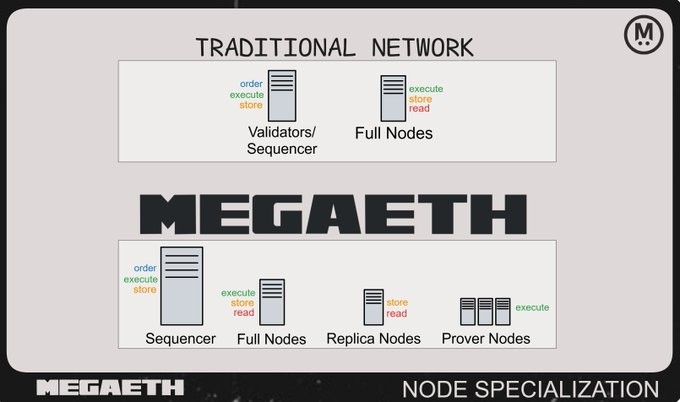
Comparison of uniform nodes with MegaETH’s specialized roles · Source: megaeth.com
Mini-blocks and response speed
Mini-blocks are described in the documentation as updates produced roughly every 10 milliseconds. Through the real-time API, applications can quickly see the network’s recent state.
This speed is not the same as irreversible settlement on Ethereum. Also, the long-term target of 100,000 transactions per second (TPS) doesn’t describe typical production traffic: performance depends on the complexity of the transactions and the test conditions.
In the January 2026 stress test, the team reported about 11 billion transactions in seven days, while an interview with Bankless cited a peak of about 55,000 TPS. These are test results, not proof of comparable everyday demand.
Storage, settlement and data
The technical optimization covers memory, storage and the continuous flow of block production. The team describes a more efficient state trie, a write-optimized storage system and bytecode compilation.
Ethereum is used for settlement and EigenDA for data availability, i.e. so that the necessary data can be retrieved and checked. The image below shows the historical depiction of the relationship between the sequencer, replicas and provers; the actual guarantees depend on what has been implemented.
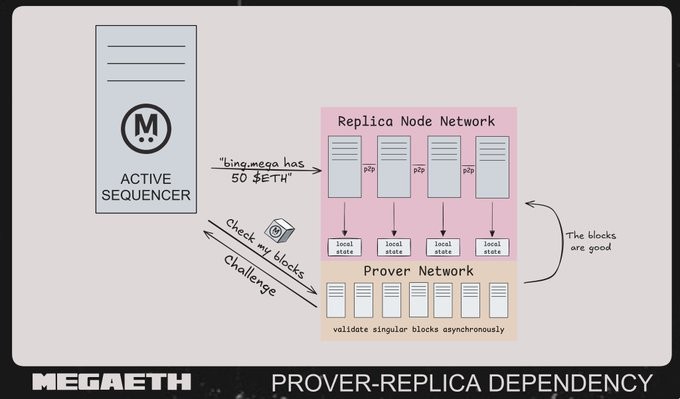
The planned communication between the sequencer, replicas and the prover network for checking blocks · Source: megaeth.com
The Bankless interview below discusses MegaETH’s performance, security assumptions, economics and applications after the mainnet launch.
Vision and roadmap
MegaETH’s vision has now broadened from building infrastructure to developing its own products. On November 10, 2026, The Block reported that the MegaETH Foundation had been renamed MEGA and committed $30 million to products.
- Early 2023 MegaLabs is founded.
- June–December 2024 A $20 million funding round and a $10 million Echo community round are announced.
- February–March 2025 The Fluffle NFT sale takes place and the public testnet launches.
- October 27–30, 2025 The Sonar public auction is held.
- January–February 2026 A stress test follows, and the mainnet launches on February 9.
- April 23–30, 2026 The team announces that ten Mega Mafia applications met the token launch condition. MEGA distribution begins on April 30.
- July 16, 2026 The Mega Mafia accelerator program is discontinued.
- November–December 2026 The rebrand is announced and an AI model execution marketplace is planned for December, not yet delivered as of November 11.
An AI inference marketplace is about running models that have already been trained. Providers, models, pricing and the exact use of MEGA had not been disclosed; the $30 million covers a range of products, not just this marketplace.
Sequencer rotation, the broader decentralized operator mechanism and faster finality upgrades also remain planned or without confirmed full production deployment. We keep what works separate from what is on the roadmap.
MEGA tokenomics and utility
MEGA has a total and maximum supply of 10 billion tokens, with more than half set aside for performance-based rewards. The following table follows CoinGecko’s detailed allocation, as the official page rounds some percentages.
| Category | Share | Tokens |
|---|---|---|
| Staking and target-based rewards | 53.3% | 5.33 billion |
| Investment funds | 14.7% | 1.47 billion |
| Team and advisors | 9.5% | 950 million |
| Foundation and ecosystem | 7.5% | 750 million |
| Echo | 5% | 500 million |
| Sonar public sale | 5% | 500 million |
| Fluffle | 2.5% | 250 million |
| Mainnet Campaign / Terminal | 2.5% | 250 million |
The last category is called “Sonar Bonus Pool” in the official MiCA document. The different names mean we can’t take an unchanging final allocation for granted.
When are the tokens unlocked?
Vesting differs by category. For the team, a one-year cliff followed by three-year linear vesting is described, but the start date needs to be checked in the contracts; for the investment funds, a fully agreed schedule has not been documented.
On April 30, 2026, according to the official page, 20% of Echo and 50% of Fluffle were unlocked, with exceptions, while the rest of Fluffle was scheduled for six months later. For the public sale, delivery is scheduled for April 30, 2026, or April 30, 2027, where a one-year lockup applies.
The 53.3% in rewards is tied to key performance indicators (KPIs), not simply to calendar-based issuance. Tokenomist estimated about 1.1 billion unlocked tokens on November 10 and modeled a schedule through 2030, but this doesn’t replace checking the contracts, nor does it make the KPI rewards linear.
There is also a discrepancy between documents: the MiCA whitepaper cites token creation on November 5, 2025, while the later announcement uses April 30, 2026. That’s why we prefer the more precise wording that MEGA entered circulation and began to be distributed on April 30, 2026.
What is MEGA used for?
The functional use described today is locking circulating or vesting tokens through Flux to take part in KPI rewards, under its rules. The team also says that foundation rewards from USDm, the ecosystem’s stablecoin built on Ethena’s infrastructure, are used for MEGA buybacks, with no guaranteed future amount.
Participation in sequencer rotation, with staking and penalties that remove locked tokens (slashing), remains planned. We don’t present MEGA as a current fee token: ETHBEAT lists ETH for execution fees (gas), while fully decentralized token-based governance has not been documented.
The team and backers
The team is public, with technical and business experience. Co-founder Yilong Li holds a PhD in computer science from Stanford and worked at Runtime Verification, while Shuyao Kong was head of global business development at Consensys. Lei Yang is listed as a co-founder and Namik Muduroglu as a member of the founding team.
The $20 million round was led by Dragonfly, with Figment Capital, Robot Ventures and Big Brain Holdings. Individual backers include Vitalik Buterin, Joseph Lubin, Sreeram Kannan, Kartik Talwar, Mert Mumtaz and Jordan Fish/Cobie. The names explain the interest, not the network’s security.
Beyond Echo’s $10 million, Fluffle raised about $13 million. Sonar had a cap of $49.95 million, with 500 million tokens at $0.0999, but Kong later cited about $40 million after the one-year lockup discounts.
The bids of about $1.39 billion from more than 50,000 participants, as reported by The Block, were not funds actually raised; other official documents give different totals. Likewise, the $27.8 billion “implied FDV” reflected oversubscription, while the maximum price corresponded to an FDV of $999 million before discounts.
In 2025 the team bought back a 4.75% stake from early investors, consisting of equity and token warrants, not a typical market buyback of MEGA. The whitepaper names Superior Performance Limited in the British Virgin Islands as the issuer; the current legal structure after the rebrand needs to be rechecked.
MegaETH information
The official addresses are collected below, with the technical documentation kept separate from the token whitepaper. The latter contains historical statements and the discrepancies we have already noted.
| Source | Official link |
|---|---|
| Network | megaeth.com |
| Technical research | Architecture and research |
| Documentation | docs.megaeth.com |
| Token | MEGA information |
| MiCA whitepaper | Token document |
| Code | GitHub |
| Community | X, Telegram, Discord |
| New corporate presence | mega.holdings |
Our take
We find MegaETH’s technical specialization interesting, but assessing it today takes more than impressive TPS figures. The central question is whether fast execution can be combined with verifiable operation and applications that keep users.
ETHBEAT notes a centralized sequencer, the hybrid Kailua proof system, limits on independent monitoring due to the availability of node source code, and admin powers. Its own maturity assessment doesn’t yet rank it at Stage 0, with a requirement under review; this alone is not proof that all funds are at risk.
In addition, it notes that in the configuration examined, the data availability certificate verifier is not used, flagging the risk of unavailable data commitments. BlockSec’s audit covered web and cloud infrastructure, with one high, four medium and one low finding reported as addressed, not every bridge and contract.
Precision is also needed regarding failures: the pre-deposit problems of November 2025, after which withdrawals were offered, were separate from Sonar. The Purrlend exploit in April 2026 concerned an application on MegaETH and HyperEVM, not a documented breach of the core protocol.
On adoption, the picture is challenging. Mega Mafia supported about 20 teams that raised about $80 million, but Kong said most of the successful applications had left; the ten applications from April don’t prove ongoing activity. About 194,800 followers on X and 8,207 Telegram subscribers are not the same as active users.
On November 10, The Block reported total value locked (TVL) in DeFi of about $12 million, down from a peak of more than $245 million. ETHBEAT’s different metric, “total value secured,” of about $91 million is neither the same TVL nor market cap.
With about 11% of the supply in circulation, future unlocks and the allocation to investors and the team need to be monitored. The reported daily volume of $16.7 million and listings on Gate, Binance and OKX don’t guarantee order book depth; availability varies by jurisdiction.
We see technical interest, but also open questions around decentralization, application retention and the token’s economic link to new products. The reliance on USDm and the still-unknown use of MEGA in the AI marketplace add uncertainty. This is an assessment of the technology and its risks, not a recommendation to buy.
Frequently asked questions
Is MegaETH the same as MEGA?
MegaETH is the blockchain and MEGA is its token. Since November 2026, MEGA is also the name of the renamed foundation entity.
Are fees paid in MEGA?
ETHBEAT identifies ETH as the fee token. Older references to MEGA for gas don’t document the current mechanism.
Do the 10 milliseconds mean a transaction is final?
No. They refer to fast mini-block updates to applications, not irreversible settlement on Ethereum.
How do you avoid confusing it with other MEGA tokens?
Check the network and contract address, not just the ticker. Coinbase lists the address 0x28B7E77f82B25B95953825F1E3eA0E36c1c29861 for MegaETH, which needs to be verified before any use.