Crypto stocks: how to check Coinbase, Strategy and the miners from their SEC filings
Coinbase, Strategy, MARA: many people invest in crypto through stocks. Where to find what you are really buying, and how to read it without becoming an accountant.


Not everyone buys bitcoin directly. Many investors get into crypto through shares of listed companies: the Coinbase exchange, Strategy (formerly MicroStrategy), which holds bitcoin on its balance sheet, or mining companies such as MARA and Riot. These companies are listed in the US, so they must file their financials with the SEC, the US Securities and Exchange Commission. That is where the most reliable answer to “what am I buying” lives.
Why a crypto stock is not the same as crypto
These stocks move with bitcoin, but behind them there are revenues, debts, executive pay and management decisions. For example, from their filings (last 12 months, prices of November 13, 2026):
| Company | What it does | 12-month revenue | 12-month result | Market cap |
|---|---|---|---|---|
| Coinbase (COIN) | Exchange | $5.6B | Loss of $702M | $34.2B |
| Strategy (MSTR) | Software and a bitcoin treasury | $495M | Loss of $13.7B | $44.7B |
| MARA (MARA) | Mining | $716M | Loss of $2.9B | $2.7B |
| Riot Platforms (RIOT) | Mining | $676M | Loss of $1.4B | $6.6B |
| Robinhood (HOOD) | Broker with crypto | $5.1B | Profit of $2.0B | $69.2B |
The big losses at Strategy and the miners don’t necessarily mean their business is going badly. Under US accounting rules, the bitcoin they hold is marked at its current price, so a price drop is booked as a loss even if they sold nothing. But you only learn things like this by reading the filings, not from the price chart.
Which filings to look at
- 10-K: the annual report. Revenue, profits, debt, risks, how much bitcoin the company holds and at what price it bought it. If it’s your first time, start with the guide on how to read a 10-K.
- 10-Q: the quarterly report, shorter, with the latest numbers.
- 8-K: one-off events, such as a new share or bond issue to buy bitcoin.
- Form 4: when company insiders buy or sell their own shares. See what Form 4 shows (and what it doesn’t).
- 13F: what the big funds hold, every quarter. More in the guide to 13F filings.
All of them are free on the SEC’s EDGAR. The problem is the volume: a single 10-K usually runs to more than 100 pages.
Ploutos AI: the filings, made readable
Ploutos AI was built for exactly this: it is a stock research tool that reads SEC filings and lays them out in plain language, so you can see what you are buying without digging through hundreds of pages. About 3,500 US-listed companies have their own page, free without an account, with revenue, profits, cash flow and the share price at the end of each fiscal year. Next to every number is the filing it comes from.
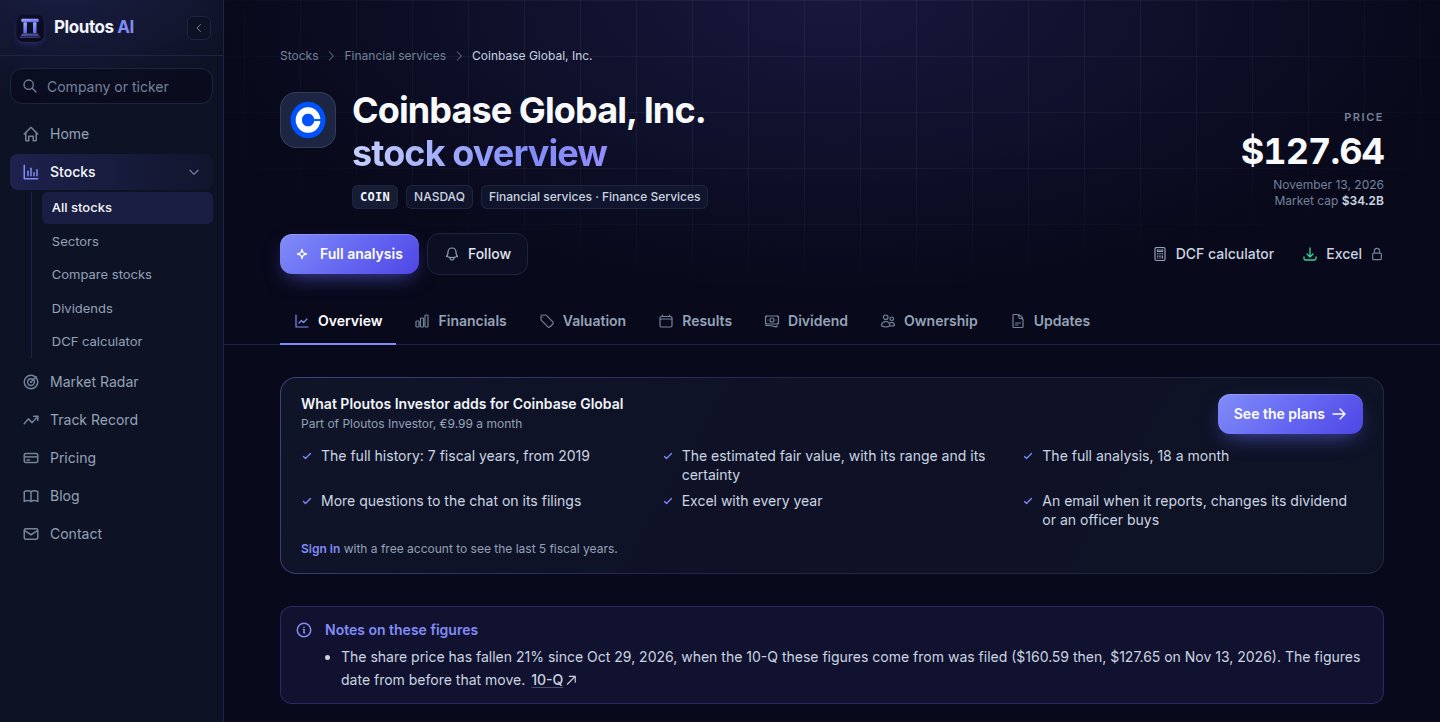
An example from the Coinbase page: the note at the top says the stock has fallen 21% since October 29, when the latest 10-Q was filed. In other words, the figures you see date from before that drop. A detail like this is easy to miss when you only look at the price.
Who is buying and who is selling
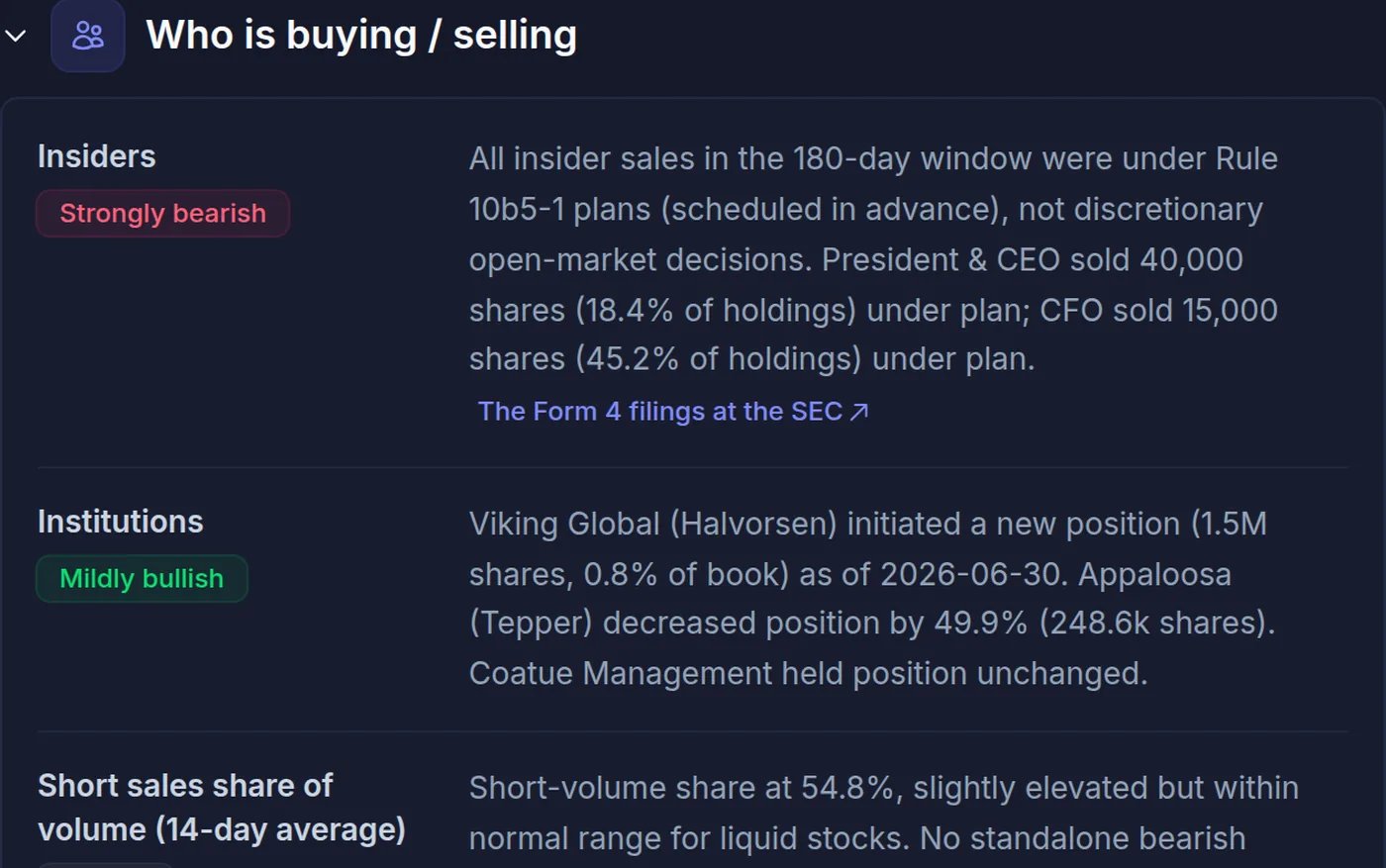
The full analysis of a stock sums up the moves of insiders (Form 4) and of the big funds (13F). For instance, if insider sales happen under pre-arranged 10b5-1 plans, set months in advance, they say less about what management believes than a sudden sale. Pictured: the analysis of Qualcomm.
The devil’s advocate
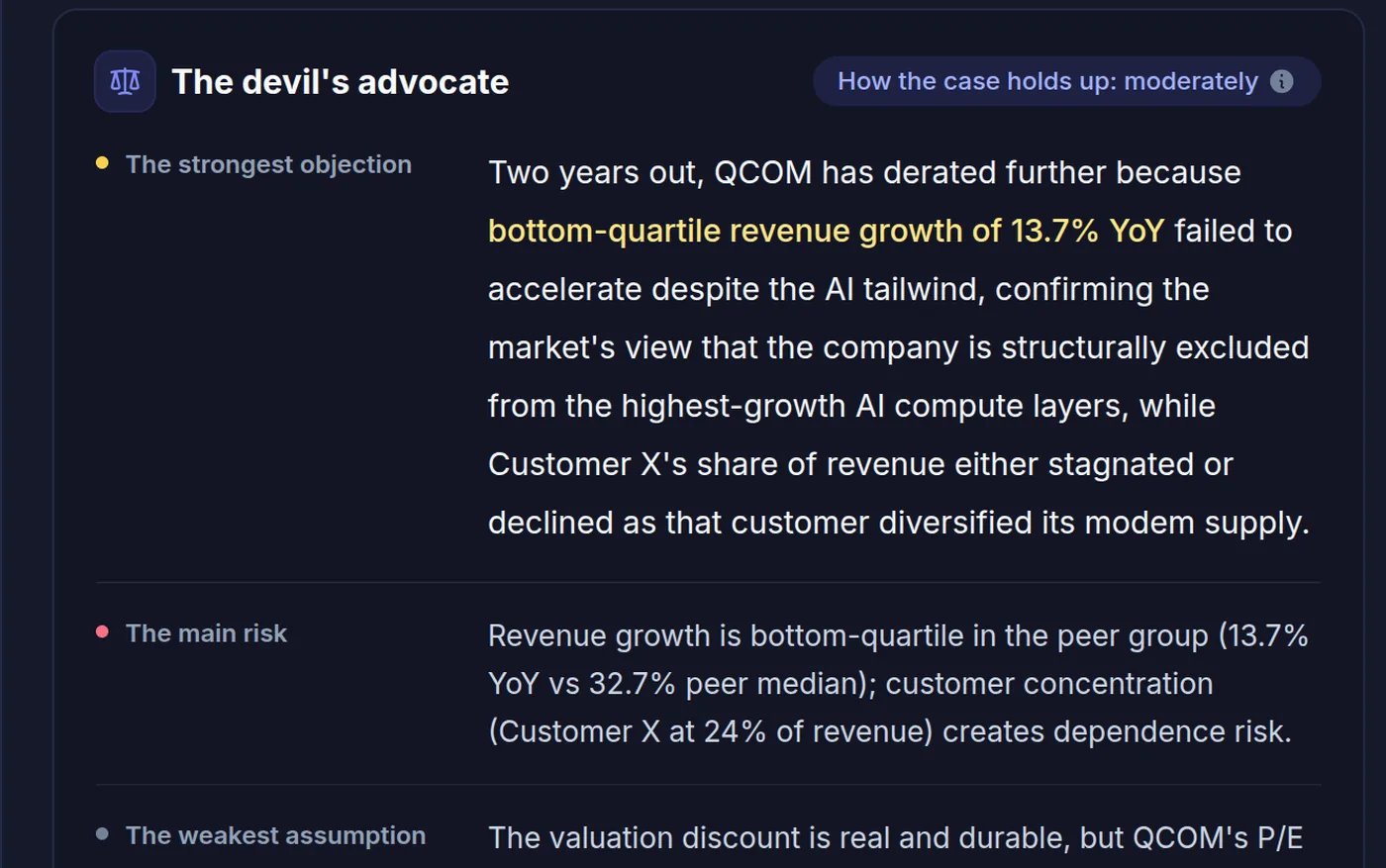
Every analysis also has a section that looks for the strongest argument against its own conclusion, and the weakest assumption it rests on. With crypto stocks, where the story is usually more attractive than the numbers, this may be the most useful part. Again from the Qualcomm analysis:
What else is free
- The DCF calculator, to see what you’d have to believe about future cash flows for today’s price to make sense.
- Stock comparison, for example Coinbase against Robinhood on revenue and margins.
- ETF overlap, for those who also hold ETFs and want to see how similar they are.
- The track record, where every past call of the tool is published against the S&P 500, including the ones that turned out wrong.
A full stock analysis needs a free account (one a month, no card). More analyses, the full history and the Excel file come with the paid plan.
A crypto stock’s price follows bitcoin. Whether it can survive a bitcoin crash is in its filings.
What to check before buying a crypto stock
- Where the revenue comes from. At Coinbase, how much depends on trading fees, which fall when the market falls.
- How much debt it has. Strategy and several miners fund bitcoin and machine purchases with bonds. MARA has net debt of $2.1B.
- How many new shares it issues. If the company keeps selling new shares to buy bitcoin, your stake shrinks.
- What insiders do with their own shares (Form 4).
- What happens if bitcoin falls 50%. Look in the risk factors of the 10-K for what the company itself says about that scenario.
What about taxes?
These are shares, not crypto-assets, so in Greece they don’t follow the new law on the 10% crypto tax. The rules for securities apply, which we explain alongside ETFs in our guide to crypto and ETF taxation. For your own case, ask an accountant.
Ploutos AI is a tool by the same maker as cryptonomy.gr. This article is not investment advice. The figures come from the companies’ SEC filings (latest fiscal year to December 31, 2025) and the prices of November 13, 2026.