Greece’s new crypto tax: 8 cases worked out with numbers
A 10% tax, a €500 exemption, 15% on staking: what each investor actually pays under Greece’s new law, in eight examples.


On November 5, 2026, the Greek Parliament passed the first law that spells out how cryptocurrencies are taxed in Greece. From January 1, 2027, the gain from every sale for euros is taxed at 10%, with a tax-free allowance of up to €500 a year. Staking rewards are taxed at 15%. The rules sound simple, but they hide pitfalls that only show up with numbers. So we follow eight investors, each with their own case, and work out their bill euro by euro.
Holding crypto isn’t taxed, and neither is swapping one crypto for another. What’s taxed is the moment you turn it into euros or pay with it.
The new tax at a glance
| From when | For sales from January 1, 2027 (first tax return in 2028) |
| Rate | 10% on the year’s net gain |
| Tax-free allowance | Up to €500 of net gain a year. Above that, the whole gain is taxed, from the first euro |
| What’s taxed | Selling for euros, paying for goods or services with crypto, contributing crypto to a company |
| What’s not taxed | Holding and crypto-to-crypto swaps |
| Cost basis | Average acquisition cost, including fees. If it can’t be proven, it’s treated as zero |
| Staking, lending, DeFi | 15%, like interest |
| Deemed-income presumptions (“tekmiria”) | Buying crypto counts as an expense. From a sale, only the capital gain covers the presumptions, not the original capital |
| Losses | Above €500 a year, carried forward for 5 years, only against crypto gains |
| Before 2027 | Voluntary disclosure within 12 months, at 10% and with no penalties |
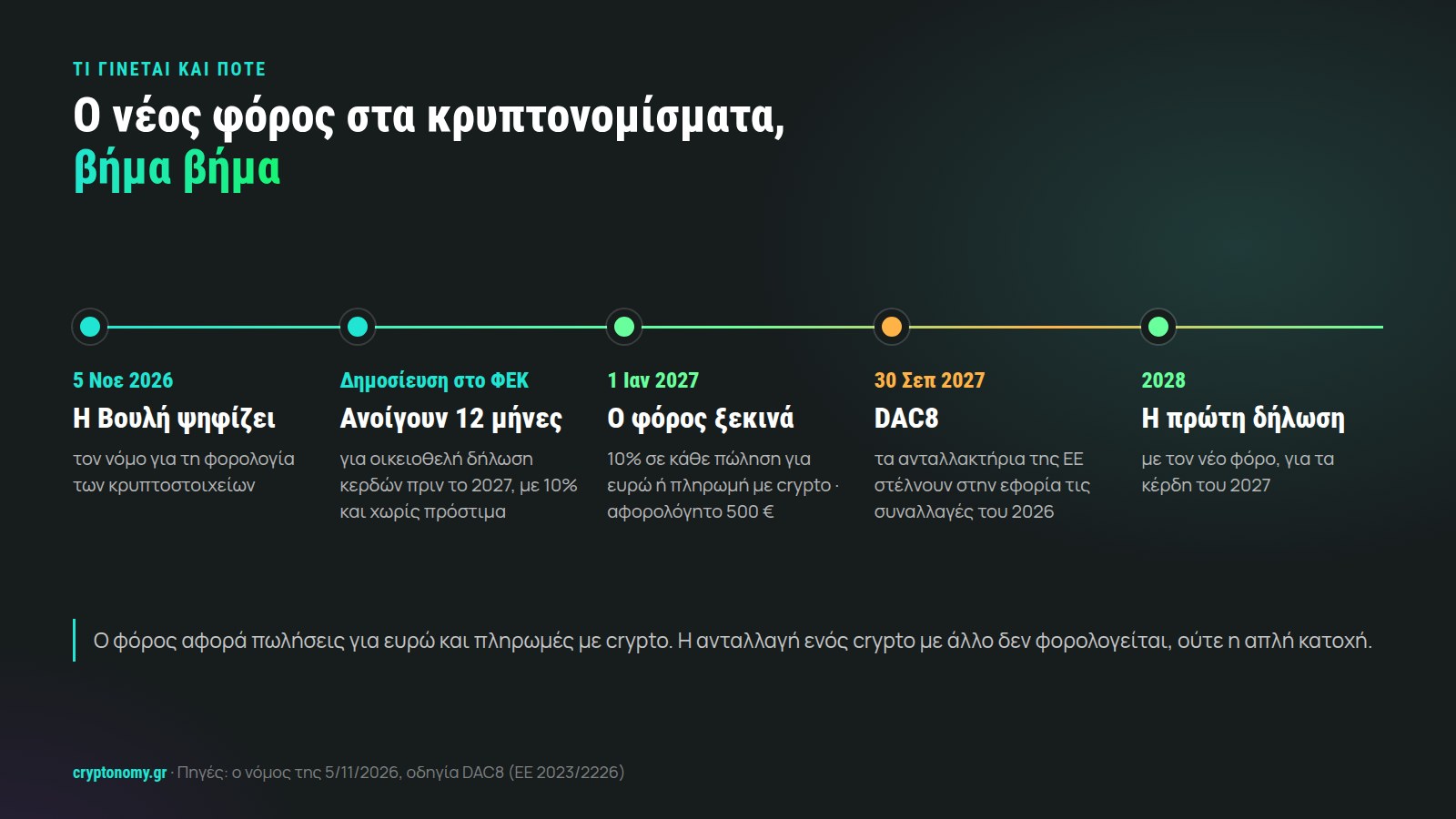
What happens and when, from the vote to the first tax return under the new tax.
Eight investors, eight tax bills
The people are fictional, but the rules are the law’s. In all the examples, the amounts are after fees: whatever you paid to buy counts toward your cost, and whatever you paid to sell is deducted from the proceeds.
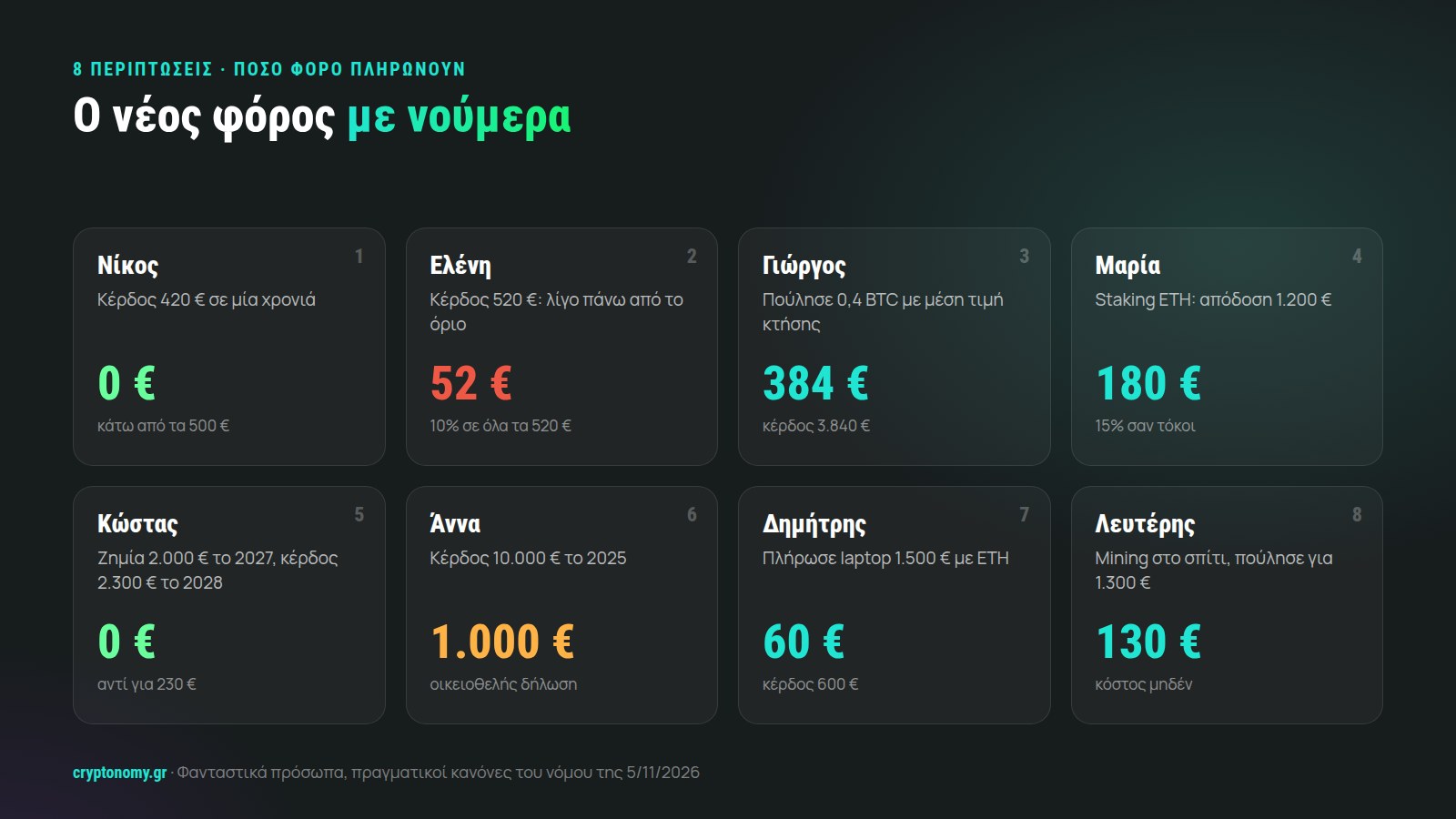
The eight cases at a glance. Details below.
1. Nikos: the small gain that isn’t taxed
Nikos is a student. In February 2027 he buys Bitcoin for €1,000. In October he sells it all and is left with €1,420 after the fee. His net gain is €420, below the €500 threshold, so tax: €0.
Does he need to report it anywhere on his tax return? AADE (Greece’s Independent Authority for Public Revenue) will clarify that in the decisions it issues. Whatever it decides, Nikos would do well to keep his exchange’s transaction statement.
2. Eleni: the €500 “cliff”
Eleni ends 2027 with a net gain of €520. Because she went over the threshold, the whole amount is taxed, not just the €20 above €500: €52 in tax. In the end she keeps €468, less than she would have kept with a €495 gain (which would have been tax-free).
This is the trickiest part of the law: around €500, one extra euro of gain costs more than €50 in tax. If you’re close to the threshold toward the end of the year, it’s worth doing the math before your last sale.
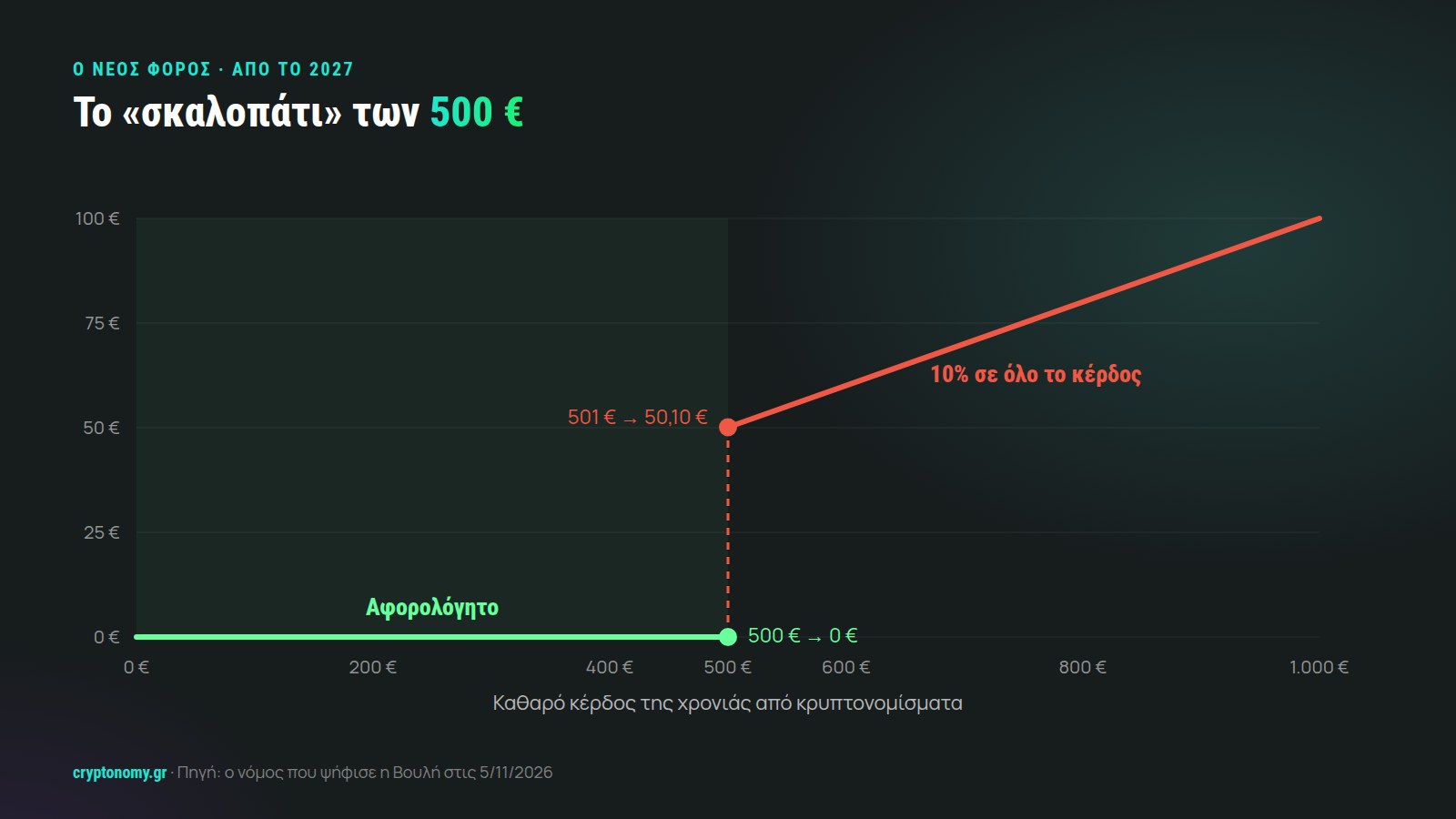
The “cliff”: up to €500 of gain the tax is zero; at €501 it jumps straight to €50.10.
3. Giorgos: buying at different prices
Giorgos buys Bitcoin in two installments and later sells part of it. The example is the same one used in the bill’s explanatory analysis:
| Transaction | Quantity | Amount | Fee |
|---|---|---|---|
| Buy | 0.5 BTC | €30,000 | €100 |
| Buy | 0.5 BTC | €40,000 | €100 |
| Sell | 0.4 BTC | €32,000 | €80 |
The law doesn’t ask which coins he sold (the cheap ones or the expensive ones). It uses the average acquisition cost: €70,200 total cost including fees, for 1 BTC, i.e. €70,200 per BTC. The 0.4 BTC he sold cost him €28,080. He received €31,920 after the fee, so a gain of €3,840 and €384 in tax. The remaining 0.6 BTC keep the same average cost, €70,200, for future sales.
4. Maria: staking, then a sale
Maria has 10 ETH that she bought for €20,000 and stakes them. During 2027 she receives 0.4 ETH in rewards, worth a total of €1,200 at the time she received them. These are taxed like interest, at 15%: €180 in tax.
The value that was taxed becomes the cost of those ETH. So she now has 10.4 ETH with a cost of €21,200, i.e. an average price of €2,038.46 per ETH. In 2028 she sells 0.4 ETH for €1,500. Their cost at the average price is €815.38, so the gain is €684.62. Since it exceeds €500, it’s taxed at 10%: €68.46. She isn’t taxed twice on the same value: the €1,200 from staking has already been taxed, so it counts as cost, not gain.
5. Kostas: the loss that “comes back”
Kostas buys Solana for €5,000 and in 2027 sells it for €3,000: a loss of €2,000. Because it’s above €500, the loss is carried forward to later years. In 2028 he has a gain of €2,300. He deducts the loss and is left with €300 of net gain, below the tax-free allowance: tax: €0, instead of €230 without the offset.
Two details: the loss counts only against crypto gains, not against salary or rental income. And a loss of up to €500 a year isn’t carried forward.
6. Anna: sold before 2027
Anna had bought crypto for €30,000 and sold it in 2025 for €40,000. The new tax applies from 2027, but the law offers a way out for gains from previous years: a voluntary disclosure within 12 months of the law taking effect, at the same 10% rate. Anna declares a €10,000 gain and pays €1,000 within 60 days, with no penalties or interest.
What does she get out of it? The declared €10,000 gain now counts toward covering the deemed-income presumptions (“tekmiria”), e.g. if she buys a car or a house. Note: only the gain counts, not the €30,000 she originally put in.
7. Dimitris: swaps and paying with crypto
Dimitris often swaps coins, e.g. Bitcoin for Solana. These swaps aren’t taxed: according to the law’s explanatory memorandum, a crypto-to-crypto swap is not a disposal. In May 2027, however, he buys a laptop worth €1,500 and pays with 0.5 ETH, which he had bought for €900. Paying with crypto is a disposal, as if he had sold the ETH for €1,500: a gain of €600 and €60 in tax.
8. Lefteris: mining at home
Lefteris mines as a hobby, not as a business. He pays no tax when he receives the coins. When he sells them, their cost is treated as zero. He sells 0.02 BTC for €1,300: the whole amount is gain, so €130 in tax. If mining is done as a business, the business rules apply. But the law doesn’t say when it becomes a business (see below).
What we don’t know yet
The law has been passed, but several details will come through AADE decisions in the coming weeks:
- Which codes on Form E1 the gains will be reported under, and whether gains below €500 will also have to be reported.
- How exactly the cost carries over from one coin to another after a crypto-to-crypto swap.
- How transfer fees count (e.g. network fees when you send to a wallet).
- The publication date in the Government Gazette (FEK), from which the 12 months for voluntary disclosure are counted.
- When mining counts as a professional activity. The law exempts only mining “outside business activity”, without defining where the line is: how many machines, how much electricity, whether it’s done systematically. If the tax office sees it as a business, you need to register a business activity and the coins count as business revenue, taxed under the business rules instead of the 10% on sale.
We’ll update the article as the decisions come out.
The tax office will know
From 2026, exchanges in the EU record their customers’ transactions and send them to the tax authorities under the DAC8 directive. The first report, covering 2026 transactions, is due by September 30, 2027. In other words, AADE will have the same numbers you do. Platforms licensed under MiCA, like those in our crypto exchange comparison, provide clean transaction statements that you’ll need.
What to do now
- Download your statements from every exchange you’ve used, for all years. Without proof, the cost is treated as zero.
- Work out your average acquisition cost for every coin you hold, including fees.
- If you sold at a profit before 2027, consider the voluntary disclosure as soon as it opens.
- Keep records of your staking: when you received the rewards and what they were worth at the time.
- Watch the €500 threshold at the end of each year.
Calculate your own tax
We built a free crypto tax calculator using the new law’s rules. You enter your purchases, sales and staking and see the average acquisition cost, the gain and the tax for each year, with losses carried forward. Your transactions stay in your browser only.
Frequently asked questions
Do I pay tax if I just hold crypto?
No. Holding isn’t taxed, and neither is a rise in value. Tax applies when you sell for euros or pay with crypto.
Is the €500 tax-free allowance per coin or per exchange?
Neither. It applies to the year’s total net gain across all cryptocurrencies and all platforms, after losses are deducted.
Are stablecoins (USDT, USDC) taxed?
Converting crypto into a stablecoin is a crypto-to-crypto swap, so it isn’t taxed. Converting a stablecoin into euros is a sale: if there’s a gain, it’s taxed.
Does it apply to exchanges outside Greece?
Yes. The tax applies to Greek tax residents, wherever the transaction took place.
This article explains the law as passed on November 5, 2026 and is not tax advice. For your tax return, consult an accountant.